


'Sylvia'.
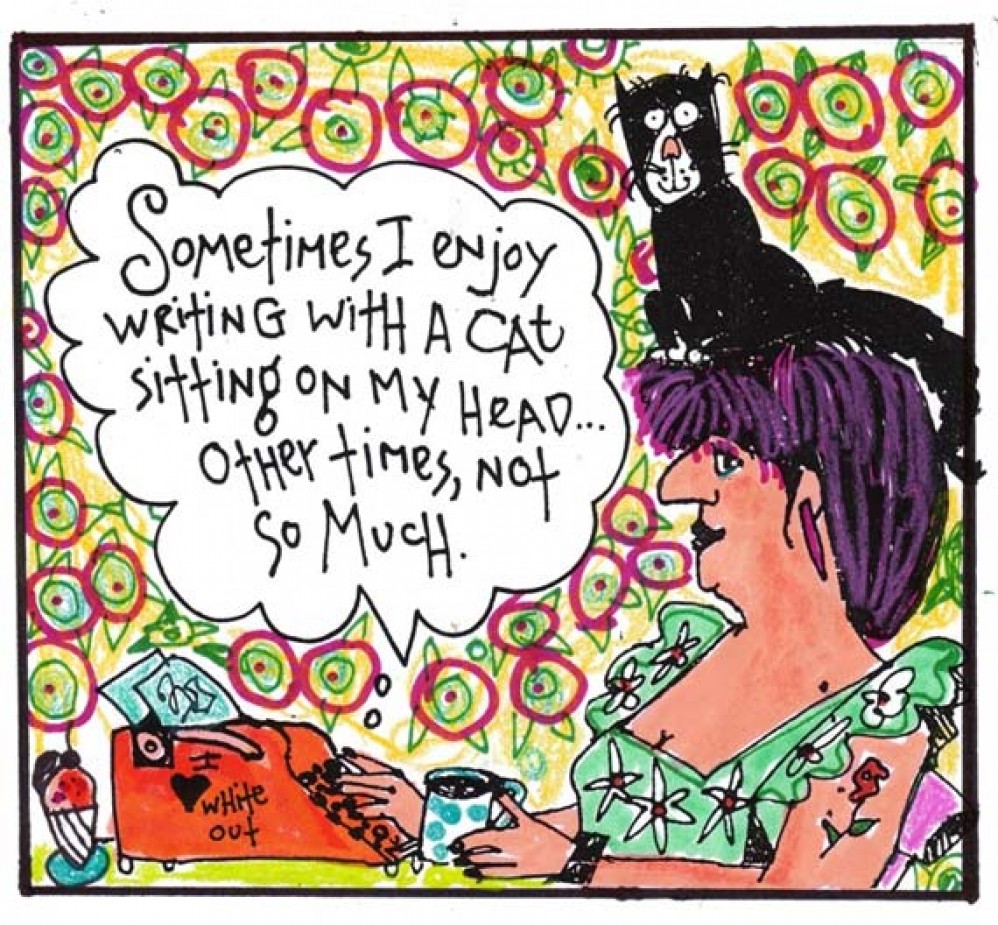
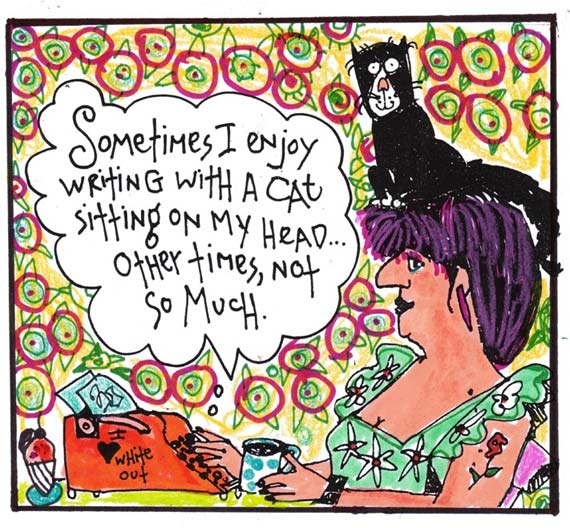
Nicole Hollander is best-known for her signature gag comic, 'Sylvia' (1980-2012), at the time one of the few US newspaper comics written and drawn by a female cartoonist. The feature distinguished itself through its ironic, political-social satire from a feminist perspective. Originating in Hollander's 1970s strip 'The Feminist Funnies' in The Spokeswoman, 'Sylvia' was one of the rare alternative comics to transition to mainstream newspapers without sacrificing its edge. The comic polarized readers, but also received a cult following, as Sylvia's snarky but witty jokes, love of cats and life-embracing attitude struck a chord with fans. 'Sylvia' spawned some modest merchandising items and was adapted into a few stage plays. At a certain point, Hollander was notable for self-syndicating her newspaper comic. She has also been active as a painter, book illustrator and lecturer.
Early life and career
Nicole Hollander was born in 1939 as Nicole Garrison in Chicago, Illinois. The daughter of carpenter and labor activist Henry Garrison, she grew up with a strong sense of political awareness and social consciousness. Despite being raised in a Jewish household, her father was an atheist and encouraged her to eat on Yom Kippur, disregarding the Jewish custom of fasting during this holiday. While he was very passionate about the civil rights of black people and homosexuals, he was no feminist. Hollander recalled that her father could often get very angry about anything, particularly the fact that he kept getting fired, or starting new businesses that weren't very successful.
Hollander's mother Shirley Mazur Garrison was a hospital administrator, whose girlfriends often came over for a cup of coffee, among them her bosom pals Olga and Esther. Hollander often overheard their hilarious conversations, which shaped her own sense of comedy. Interviewed in Mother Jones Magazine (June-July 1987), she reflected: "I got the idea that women's friendship was really important and that that's what lasted. My mother had friends forever - she had friends from when she was a teenager - and I really felt that in the company of women you could have the most fun. So in the 'Sylvia' strip, women are sitting around with food, and across the table, and the strip is about conversations." Interviewed by Jan Tuckwood for the Palm Beach Post (21 November 2014), Hollander added: "These women were hilarious. They did a lot of tap-dancing around men in those days. You know, if a man has a cold it's equal to you having the plague. My mother and her friends would talk about their husbands over coffee, and these fascinating, renegade parts of their personalities would come out."
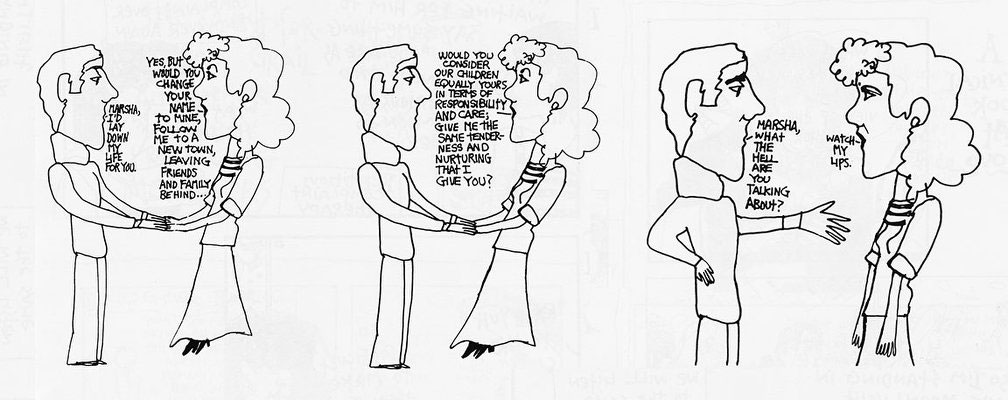
Early comic strip by Nicole Hollander.
Between 1956 and 1960, Nicole Garrison studied painting at the University of Illinois, where she graduated with a BFA. There, she also met the Hungarian sociologist Paul Hollander, whom she married in 1962. However, they soon found out that their backgrounds and ideological viewpoints were incompatible. As she reflected on her blog (11 April 2011), Hollander couldn't divorce him, because the state of Massachusetts only allowed physical cruelty or adultery as grounds for such an agreement, and such accusations would ruin his academic career. A "very seedy" lawyer suggested to Hollander that "sexual perversion" might be a third option for divorce, but once he started reading her a list of these acts, she stood up and left. Eventually, in 1966 she travelled all the way to El Paso, Mexico, where she received a cheap and straightforward "Mexican divorce". She did keep her ex husband's last name and used it as her pen name.
After achieving her MFA at Boston University in 1966, Hollander moved to Berkeley, California, where she worked a variety of odd jobs. This has included working in a bakery, at a day care center, selling cold custard, working in a hat store, as telemarketer for a bank, and as a sandwich maker. While living in California, she decided to venture into graphic design. Unable to find work in the Bay Area, she returned to her hometown Chicago to pursue that career path. At this point, she had no intention of becoming a cartoonist.
Although she enjoyed comics as a child, Hollander lost interest at a certain point, "but I can't remember why… maybe the comics stopped being relevant to my life because they were all written by men, filled with male characters." Graphically, she was strongly influenced by German Expressionist artists. She later also expressed admiration for the cartoonists Lynda Barry, Alison Bechdel and Claire Bretécher, as well as Russell Myers' 'Broom-Hilda' strip.
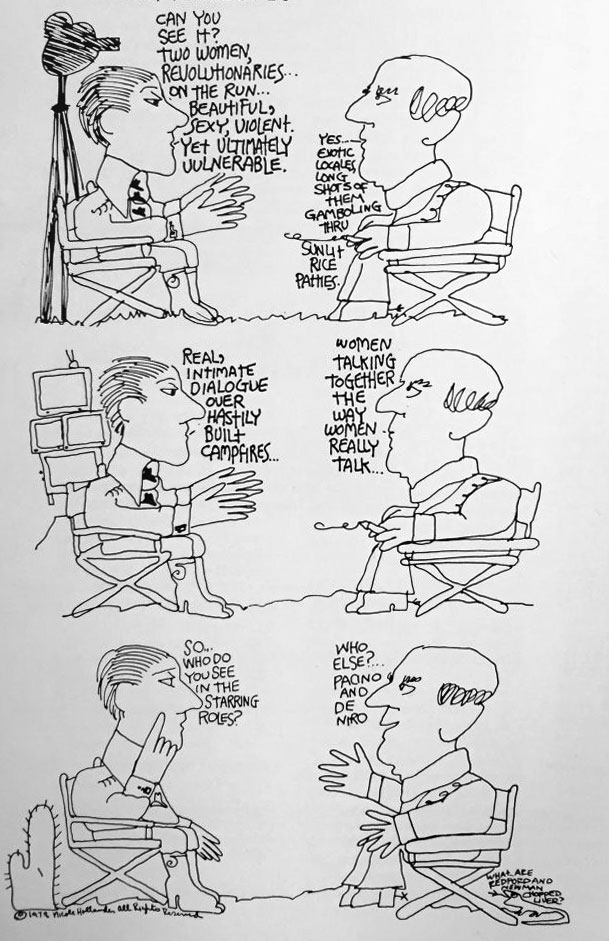
From: The Spokeswoman (15 April 1978).
Feminist Funnies
It wasn't until the 1970s before Hollander first started cartooning. While she was working in a studio in the Monadnock Building in Chicago, she met two women who worked for the feminist newsletter The Spokeswoman and soon joined in. Hollander redesigned the publication, turning it into a monthly magazine with a professional look. Sometimes she livened up pages with political-social cartoons. In these early years, her comics were mostly pantomime, in sharp contrast with her later, more dialogue-heavy comics.
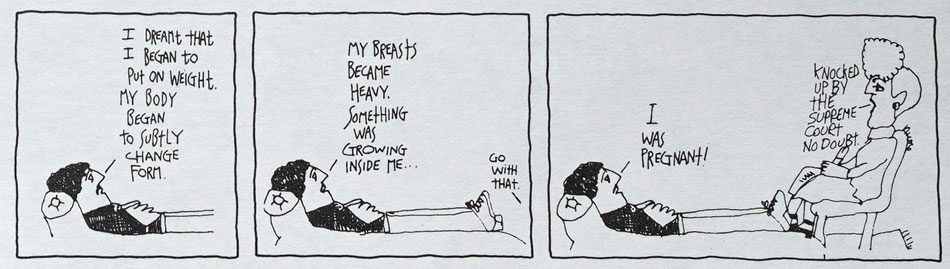
'The Feminist Funnies' (1976).
In 1976, Hollander's cartoons developed into the comic feature 'The Feminist Funnies', in which she humorously commented on then-current events from a feminist perspective. Becoming popular, 'The Feminist Funnies' were collected on a calendar, 'Witches, Pigs and Fairy Godmothers: The 1978 Feminist Funnies Appointment Calendar'. One female editor at the magazine Doubleday in New York believed in Hollanders' work, but had a hard time convincing her male editorial board, who judged it as being "too feminist". When she sent Hollander's comic to Michael Denneny, an editor at St. Martin's Press, he applauded her "sharp humor and political edge." He signed her and helped her publish her first cartoon collection, 'I'm In Training To Be Tall and Blonde' (St. Martin's, 1979).
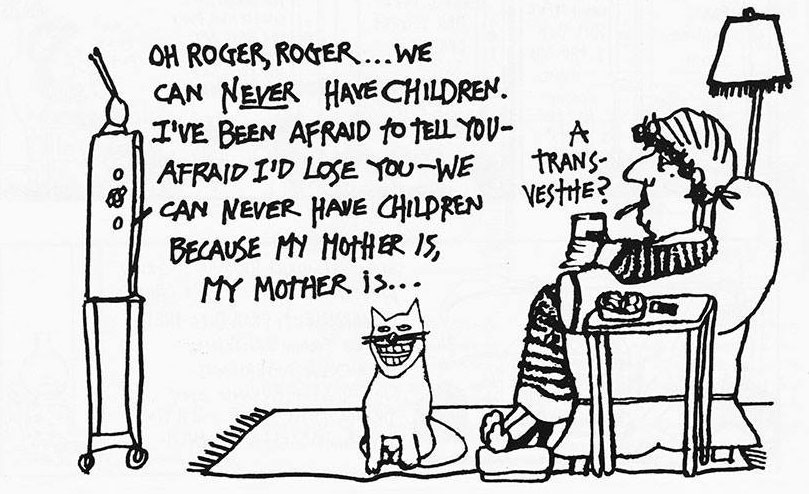
'Sylvia'.
Sylvia
Thanks to strong sales of her 'Feminist Funnies' book, Hollander was contacted by the Field Newspaper Syndicate to make her own daily newspaper comic. One of her recurring characters from 'The Feminist Funnies', Sylvia, became the protagonist. On 21 March 1980, the 'Sylvia' feature made its print debut. Within a year, it was running in The Chicago Sun Times, The Detroit News, The Los Angeles Times and The San Francisco Chronicle. At the time, Hollander had just turned 40, making her one of a select group of cartoonists to debut at middle age. Along with Cathy Guisewite ('Cathy', 1976-2010) and Lynn Johnston ('For Better or For Worse', 1979-2008), Hollander was also one of the few female comic artists with a nationally syndicated newspaper comic in the 1980s.
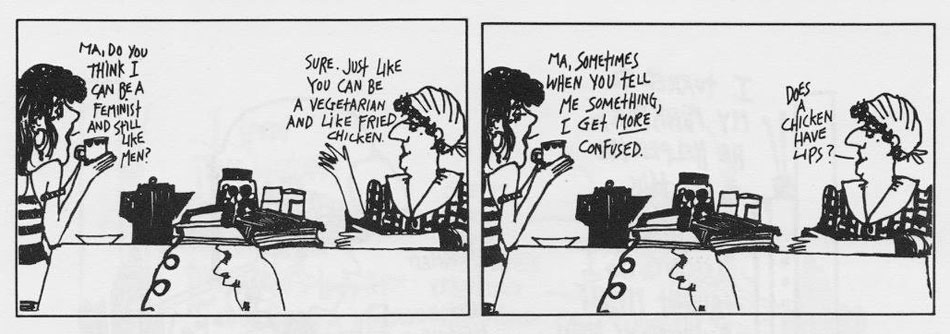
'Sylvia'.
Sylvia: style and humor
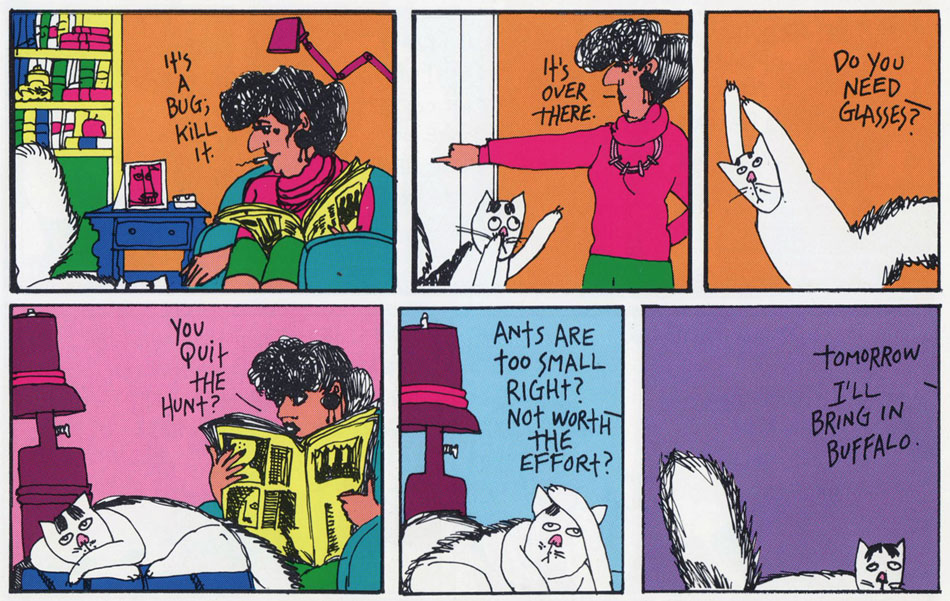
Sylvia is a middle-aged lady, often seen in garish outfits, earrings, hairdos and hats. In many gags, she gives snappy comeback answers to anything she considers trite or offensive. Men making sexist remarks in bars, but also women concerned about trivialities regarding their physical appearance or relationships. When Sylvia reads a cheap romance novel, or watches a corny movie or soap opera, she can't resist giving a snarky comment. In one gag, for instance, she watches TV, where a man says to his girlfriend: "Honey, I love you... but I got to be moving on." Sylvia's reaction: "Break his kneecaps!".
In some gags, she appears to have her own advice column and is seen typing humorous answers to readers' questions that are serious-intended. She is likewise not fooled by political speeches or sensationalized news reports. The character has a daughter, Rita, but it remains an open question whether Sylvia is single or not. She is sometimes seen in the company of her ex-husband Harry, who owns a bar. Sylvia's best friend is Beth-Ann, who works as a waitress.
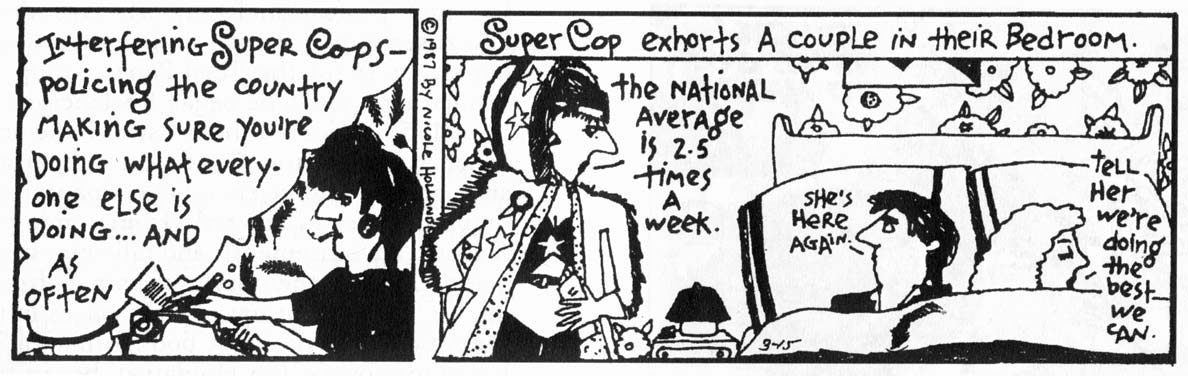
'Sylvia'.
While 'Sylvia' is comparable to many similar slice-of-life comics (made by female cartoonists), Hollander distinguished herself in several ways. Some gags are homely and recognizable, inspired by personal anecdotes. But from time to time, Hollander moved away from realism, bringing in anthropomorphic animals, angels, extraterrestrial aliens, fairy godmothers and even the devil. One of these weird characters was "the Love Cop", a police officer who tries to keep couples together who are "politically incompatible", because "love doesn't last, politics do." Other recurring characters are reporter Patty Murphy, Gernif the Venusian and the "Woman Who Worries About Everything". The cats in Sylvia's household also have the ability to communicate with their owner by holding up tag-team signs with written questions and answers. All these elements gave 'Sylvia' a slightly surreal vibe.
'Sylvia'.
Sylvia: controversy
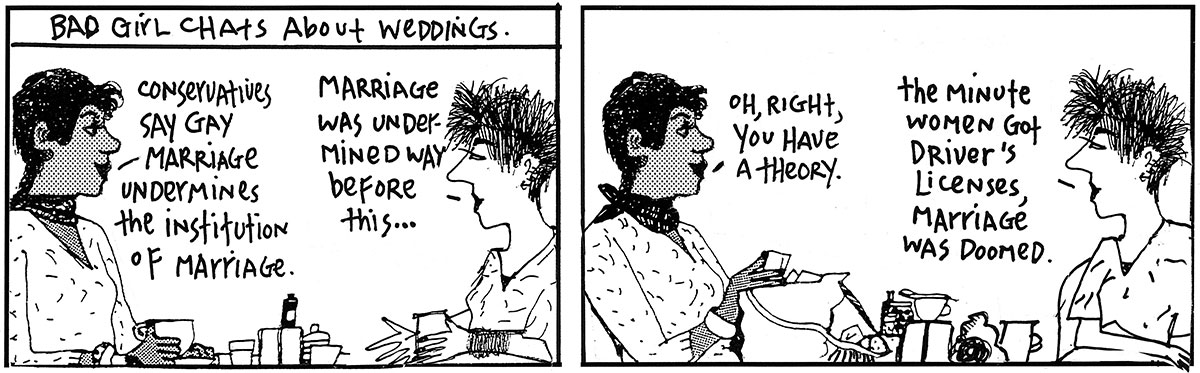
Hollander also frequently delved into taboo subjects, ranging from politics, LGBTQ rights to topics like hemorrhoids and diaphragms. In one gag, for instance, Sylvia is watching a news report: "Spokesmen for the right wing of the Republican Party are trying to associate the Democrats with a so-called feminist agenda… that causes women to leave their husbands, kill their children, practice witchcraft, destroy capitalism, and become lesbians." Sylvia dryly comments: "Heavy schedule." In another gag, the announcer states that the Senate has passed a bill today "that would outlaw abortion unless the doctor's life is in danger." Such pointed satire was quite remarkable for a syndicated newspaper comic. At times, 'Sylvia' looked more like a comic strip that belonged in an alternative weekly but somehow stumbled into nationally distributed papers. It gained her a cult following, but also polarized readers.
In the 13 July 1983 gag, Sylvia watches a report that states that "the brain in men and women is wired differently", whereupon she comments: "In men, the wires are loose." The gag caused many angry letters. Another time, somebody wrote "feeling disgusted" that their daughter had to read a comic strip about women having "their period." Hollander also once received a phone call from somebody at Mobile Oil who didn't like a joke made at the expense of the company. At first, Hollander was afraid of being sued, until she asked the caller what his job was. It turned out he was merely an employee "waiting for promotion", so she instantly knew he had no power at all. Only once did Hollander write back to a man who expressed his hatred for 'Sylvia', informing him that it is "only a tiny comic that you could easily skip over". It didn't calm him down and he wrote that her comic strip was comparable to "looking at a leper. The running sores captivate you."
Hollander's editors at the syndicate advised her to leave such potentially controversial topics behind, to avoid getting cancelled. In the 1987 Mother Jones interview, Hollander reflected: "I gave up the hemorrhoids, but not the Lightdays. There was this voice in my head that said: 'You must take a stand.' So I said, 'I will take my stand for Lightdays, and throw hemorrhoids to the dogs'." In 1982, Hollander was informed by two women working for her syndicate that she would soon be dropped by the Chicago Sun Times. This gave her time to rally as many people as possible to save her comic strip. Terri Hemmert, a deejay from Chicago, started reading suspended 'Sylvia' comics on her radio show, encouraging fans to write or phone the paper. After hundreds of angry reactions and pleas, 'Sylvia' returned to the Chicago Sun Times after only a week of absence.
'Sylvia'.
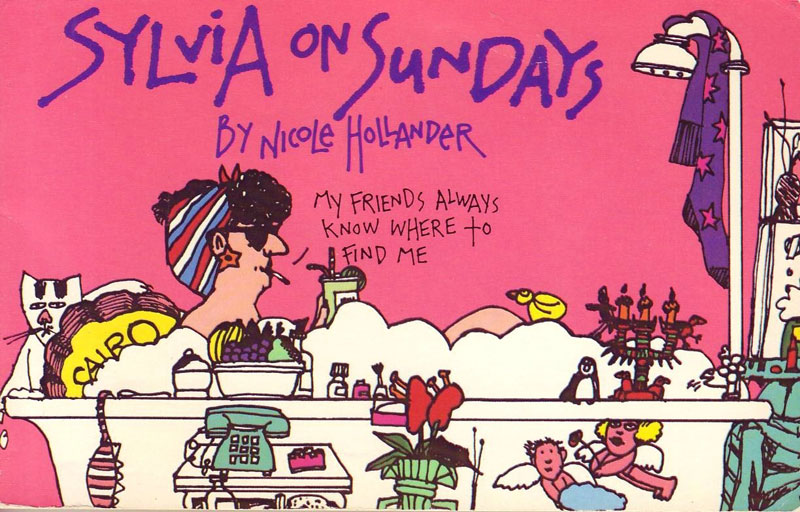
Hollander was lucky to have a loyal cult fanbase who kept her edgy comic in print for decades. Novelist Sara Paretsky praised 'Sylvia': "There are precious few women cartoonists, and Nicole is the only one with a daily strip who presents the believable struggles of women in contemporary society." A large part of Sylvia's appeal can be attributed to her aimable, endearing personality. Although her commentaries can be pointed, she is more ironic than a cynic. Her witty quips put life's banality and agony into the right perspective. Sylvia also enjoys life to the fullest. Hollander often portrayed her protagonist smoking cigarettes, sipping martinis or taking bubblebaths. She once joked: "Sylvia never seems to stand up, she's always sitting or lying down in a comfortable position." The character is also often surrounded by cats. Hollander likes cats, because "they symbolize the most self-involved part of our personalities." Sylvia is often interpreted as the cartoonist's alter ego, though Hollander downplayed this correct observation slightly: "Sylvia speaks her mind, she's never at a loss. I'm often at a loss for words." Hollander also stated that Sylvia was "10 years older than myself".
'Sylvia on Sundays' book collection.
Sylvia: success
In 1982-1983, Hollander left the Field Syndicate and started self-syndicating her comic strip, resulting in a heavy additional workload of handling all the correspondence and administration. In a 14 March 1993 interview with the San Francisco Chronicle, Hollander mentioned that her syndicates in the USA (Field) and Canada (Toronto Sun Syndicate) were not interested in pushing her work, as it was "guys selling to guys". By the time she began selling 'Sylvia' directly to newspapers, she received help from her Florida-based representative Jacque Parsons, who "had the brilliant idea of telling male newspaper editors that if they don't like the strip to try it out on their wives", which helped.
By 1997, 'Sylvia' ran in over 80 daily and weekly newspapers across the USA and internationally, for instance in the New Zealand feminist weekly Broadsheet. In its later years, the 'Sylvia' strip found a new homebase with professional syndicates, first the Los Angeles Times Syndicate (1997-2000), then Tribune Media Services (2000-2012). The cartoonist designed and distributed greeting cards, calendars and dolls with 'Sylvia' for Maine Line and Recycled Cards. 'Sylvia' was collected in many books, published from 1987 on by Random Books. The compilation book, 'The Sylvia Chronicles: 30 Years of Graphic Misbehavior from Reagan to Obama' (2010) had a foreword by veteran cartoonist Jules Feiffer. 'Sylvia' has also been adapted into two theatrical musicals, 'Female Problems' and 'Sylvia's Real Good Advice' (1991). The latter was crowned with a Joseph Jefferson Award (1991).
'Sylvia' was a newspaper mainstay for over thirty years, though by 2010 it only ran in a handful of publications. In February 2011, the Chicago Tribune cancelled 'Sylvia'. For Hollander, this was a watershed moment, since she now no longer could be read in her home city. On 26 March 2012, 'Sylvia' was discontinued completely. Hollander established a now-defunct personal blog to repost old comics and post new ones. Apart from her own opinions and work, she also offered room for articles and cartoons by younger artists. Her blog received the title Bad Girl Chats. Hollander quipped: "You have to be careful when you type in the URL, because you may get a porn site" (which ironically enough it became after Hollander's site was discontinued).
Comic for Mother Jones Magazine.
Other publications
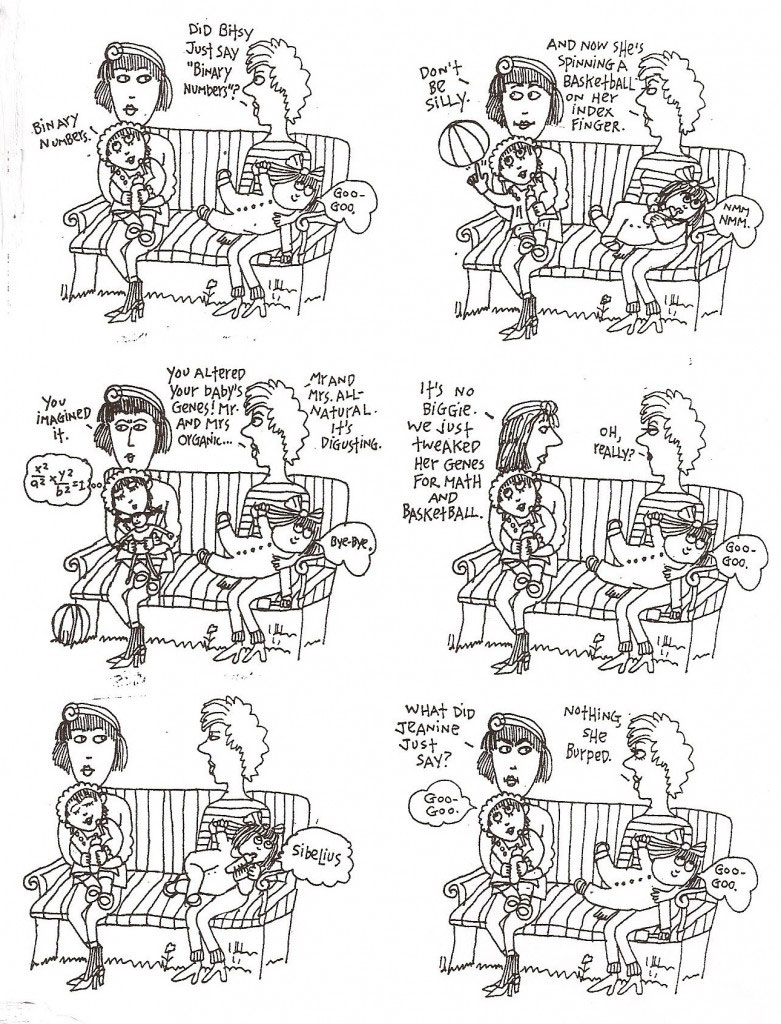
Between the late 1980s and early 1990s, Hollander also drew comics for Mirabella, Mother Jones Magazine and The New York Review of Books. These were exclusive works that didn't star Sylvia, but did feature Hollander's familiar feminist satire.
We Ate Wonder Bread
In 2018, Hollander published 'We Ate Wonder Bread: Growing Up on Chicago's West Side' (Fantagraphics, 2018), a combination between a memoir and a graphic novel. The book reflected on her childhood and came about when she googled her former address and discovered her old house and street still looked similar to the way it did in the 1930s, 1940s and 1950s. Hollander remembered many anecdotes, which she decided to not just write down, but also visualize in drawings. She sketched out many things, leaving some of the rough ones in the final printed version. Contrary to 'Sylvia', which was mostly printed in black-and-white, 'We Ate Wonder Bread' had color illustrations. The foreword was written by Alison Bechdel.
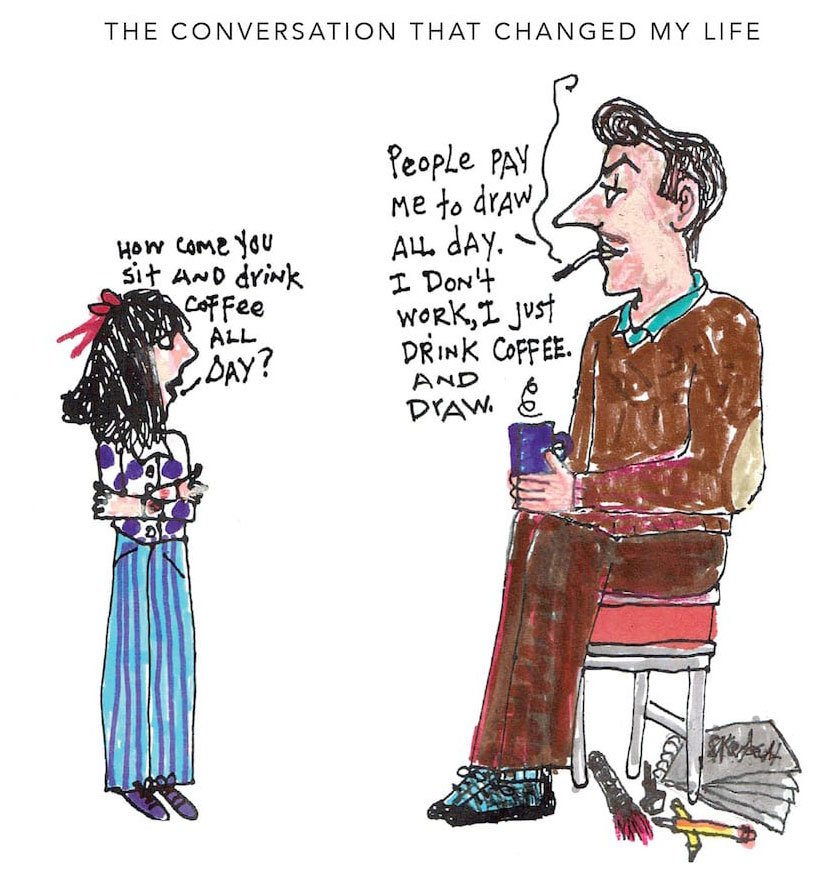
From: 'We Are The Wonder Bread' (2018).
Book illustrations
Nicole Hollander has illustrated books by many writers, including children's books by Robie Harris: 'Messy Jessie' (1987), 'Hot Henry' (1987), 'I Love Messes!' (2005), 'I'm All Dressed!' (2005), 'I'm Not Sleepy!' (2005) and 'I'm So Mad' (2005). As a feline enthusiast, she was a natural for livening up the pages of Allia Zobel's cat-themed books, like '101 Reasons Why a Cat is Better than a Man' (1994), 'Women Who Love Cats Too Much' (1995), '101 Reasons Why Cats Make Great Kids' (1996), '101 More Reasons Why a Cat Is Better Than A Man' (1997) and 'Everything I Know About the Rat Race, I Learned from My Cat' (1999). Her artwork also adorned the pages of Elizabeth Hilts' 'Getting in Touch with Your Inner Bitch' (Hysteria, 1994) and 'The Inner Bitch: Guide to Men, Relationships, Dating, Etc.' (Hysteria, 1999) and Gina Barreca's 'An ABC of Vice: An Insatiable Woman's Guide' (Bibliopola Press, 2003) and Sabrina Rivers' 'The Task-Deductible Wedding: More Wedding and Fun, Less Fret and Debt' (GPP Life, 2010).
In 2009, Hollander curated 'And You Think This Is Funny?', a show about female comedy, held at the Chicago's Woman Made Gallery.

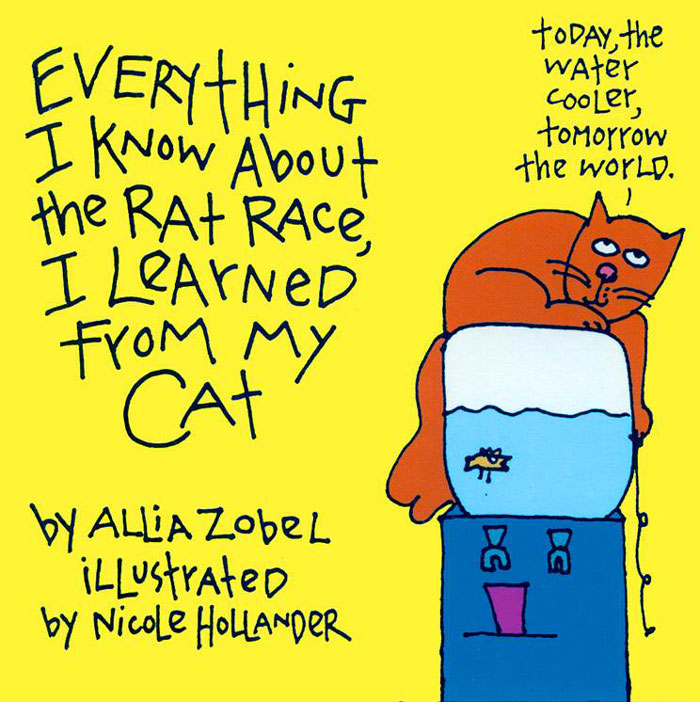
Cover illustrations for two of the cat books by Allia Zobel.
Recognition
In 1983, Hollander received the Wonder Woman Foundation Award for Women of Achievement over 40 and Yale's Chubb Fellowship for Public Service (1985). Between 25 October and 17 November 2013, her work was exhibited in the Lillstreet Gallery in Chicago, Illinois.
In 2018, Hollander donated her archives to the Billy Ireland Cartoon Library & Museum at Ohio State University. Earlier, in 2012, she had also donated her unique collection of condom packages and sex toys to the Kinsey Institute for Research in Sex, Gender and Reproduction.
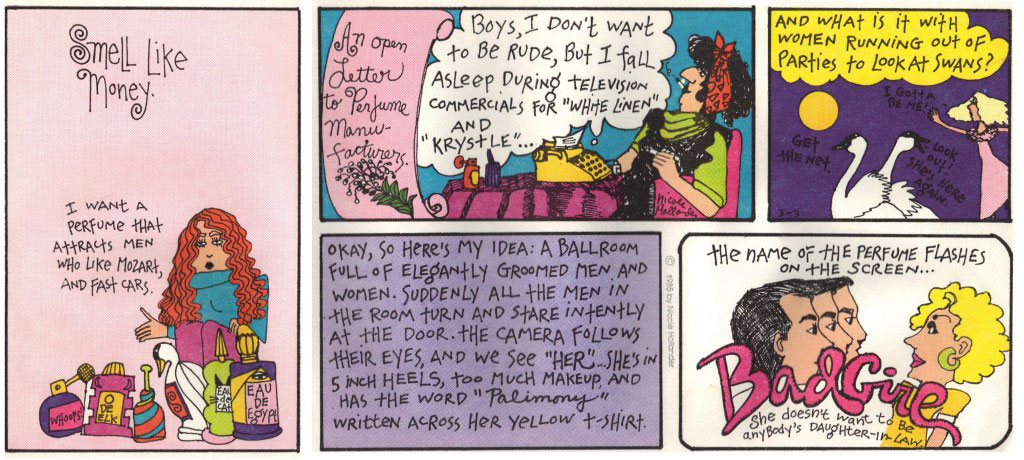
'Sylvia'.
Legacy and influence
In addition to her work in print media, Nicole Hollander performed two one-woman shows, 'Return to Lust' (2005) and 'Plastic Surgery or a Real Good Haircut' (2008). Hollander has also been active as a public speaker at schools and universities, including as an instructor at the Art Institute of Chicago and Lilstreet Art Center since September 2011.
Nicole Hollander was a close friend of cartoonist Heather McAdams and also encouraged Alison Bechdel when she was still a struggling amateur. Apart from Bechdel, Hollander was also an influence on Matt Groening, who placed 'Sylvia' on number 58 in his personal list of "100 Favorite Things."
Barbara Ehrenreich once described Hollander as follows: "America's top-flight intellectuals will one day hold entire conferences and seminars devoted to Sylviology. They will deconstruct her frame by frame with a straight edge and compass, attempting to identify each tiny object as an artifact of our time and a clue to our condition. They will bring in leading neurologists, phrenologists and psychoanalysts to study the blabbermouth pets, the thimble-sized martinis, the neurotic superheroes, to answer the inescapable question: "What kind of a mind…?"."
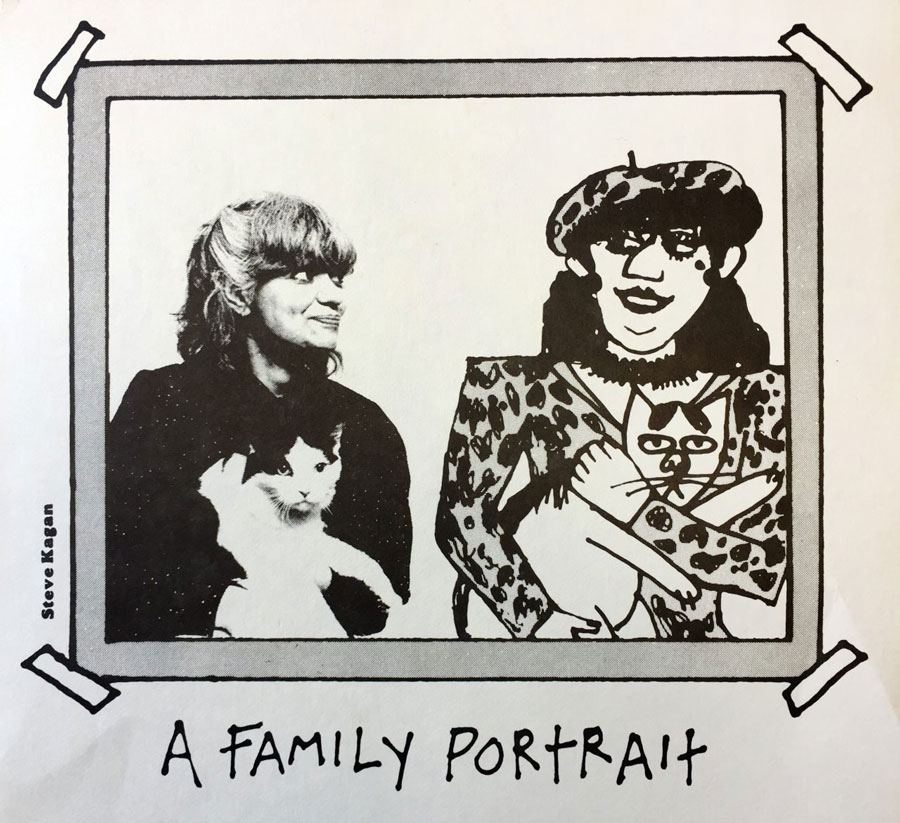
Nicole Hollander and Sylvia.