


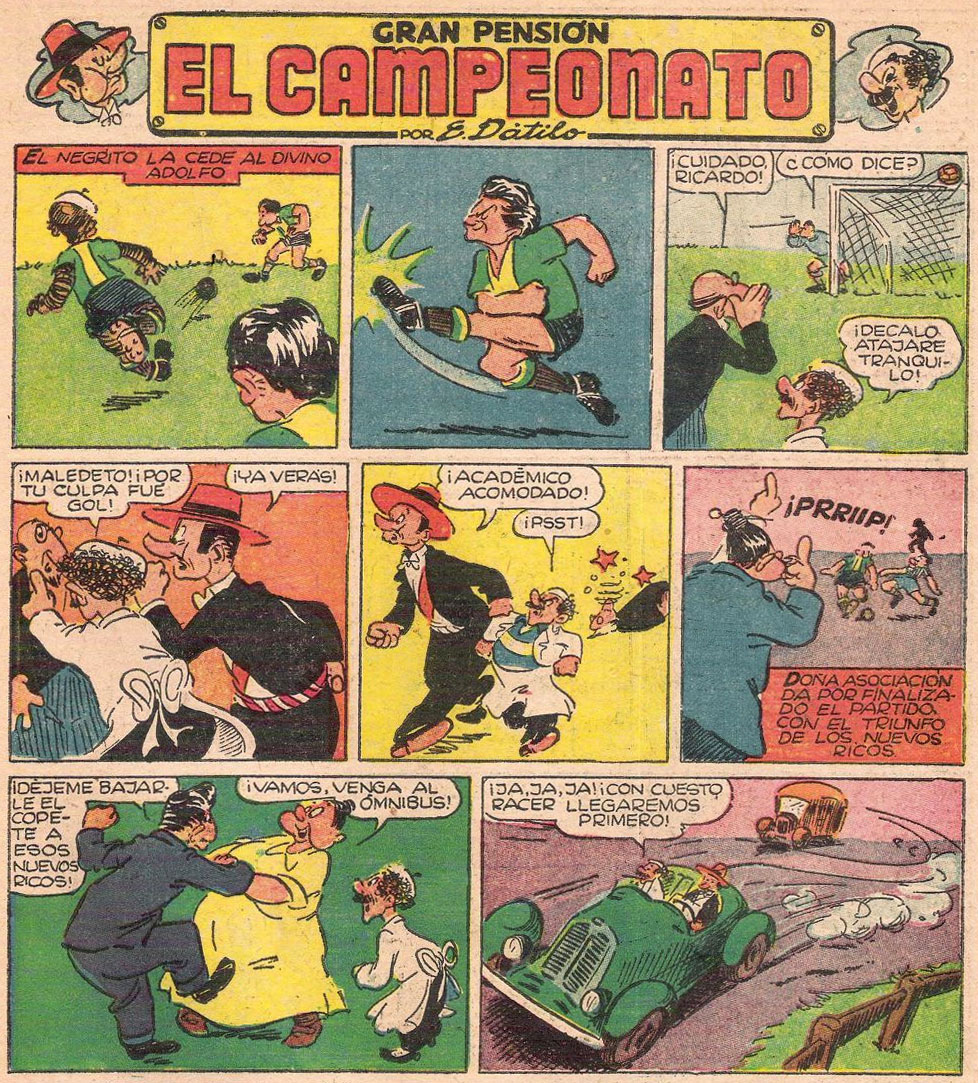
'Gran Pensión "El Campeonato"' (El Pato Donald, 1946).
Luis Destuet was the first South American artist of Disney comics, starting out as the local cover and story artist for the Argentinian magazine El Pato Donald. Over a period of 15 years, he wrote and drew several stories with Donald Duck, as well as other Disney characters like Li'l Bad Wolf and Mickey Mouse. During the 1950s, Destuet also joined Brazil's local production of Disney comics, both as an artist and as a tutor of a new wave of domestic artists. For El Pato Donald, he also made a non-Disney comic based on the radio show 'El Gran Pensión "El Campeonato"'' (1946). In addition, he had his own comic in Salgari magazine, 'Trabucu y Trinquete' (1947-1948), and was active as a writer and illustrator of children's books.
Early life and career
Not much is known about the life of Luis Amador Destuet. Born in Buenos Aires in 1920, his first known work was as an assistant on the 1942 animated short 'Úpa em Apuros', starring Dante Quinterno's 'Patoruzú' character. In 1944, he appeared in the newspaper La Razón with a strip about the mischievous gaucho 'Abrojo'. The feature later continued in El Mundo.
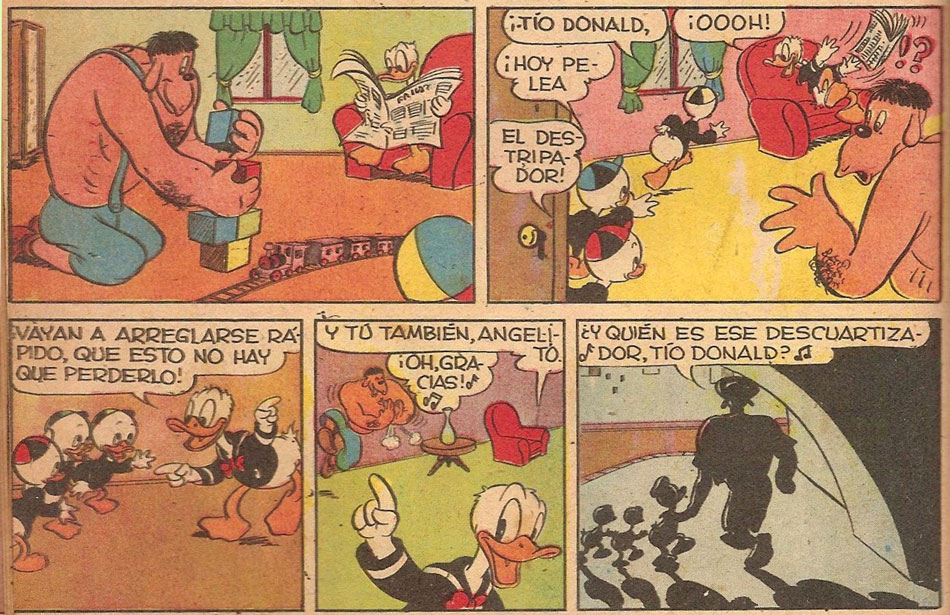
'Donald y el "Cachascán"', starring strongman Angelito (El Pato Donald #77, 1946). © Disney.
Argentinian Disney comics
In 1944, Destuet began his collaboration with Editorial Abril in Buenos Aires, the new company founded by Cesare Civita, a Jewish refugee from Italy, who was also the representative of Walt Disney Productions in South America. On 18 July 1944, Abril launched the first Argentinian Disney magazine, El Pato Donald y Otras Historietas. Quickly rising to a print run of 250,000 copies, the magazine was initially filled with reprints of US Disney material, complemented with translated non-Disney comics (hence the "y Otras Historietas"). Shortly after the launch, Abril began hiring local artists for additional cover illustrations, Luis Destuet and Salvador Schiffer. On 3O October 1944, Destuet's first contribution appeared on the cover of El Pato Donald #12: Donald Duck as a soccer player, a topic the artist continued to tackle in the following years.
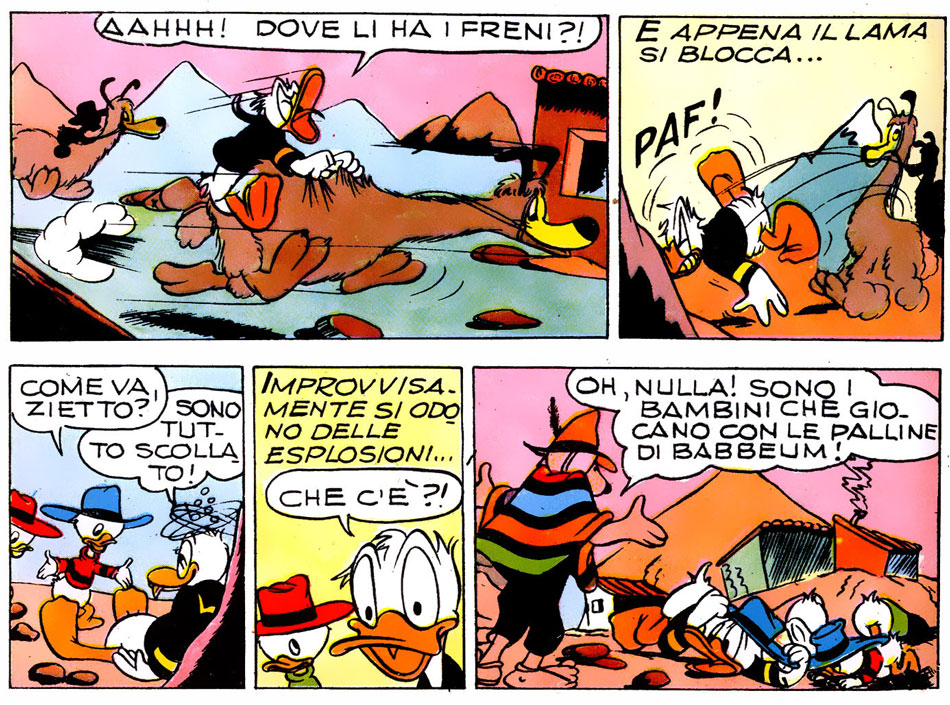
'Donald y la Atómica' (Italian edition, 1953). © Disney.
By 1945, the publisher had to drop its non-Disney content, leaving Civita with gaps to fill. Since he already had Destuet on his payroll, he commissioned the artist to write and draw original stories with Donald Duck, which also offered the opportunity to explore subjects and settings that would specifically interest the Argentinian audience. In El Pato Donald #40 of 17 April 1945, Destuet's first Donald Duck serial took off, 'Donald el Gran Goleador', which continued in the seven subsequent issues. It was also the first of several Destuet serials showing Donald in a soccer setting, in this case him being the top scorer of the Naso Juniors, prompting the manager of the rival team, regular Disney villain Pete, to kidnap him. The story also introduced the dim-witted strongman Angelino Miraflores, who continued to appear in subsequent stories, for instance Destuet's second serial, in which Angelino becomes a wrestler with Donald as his manager.
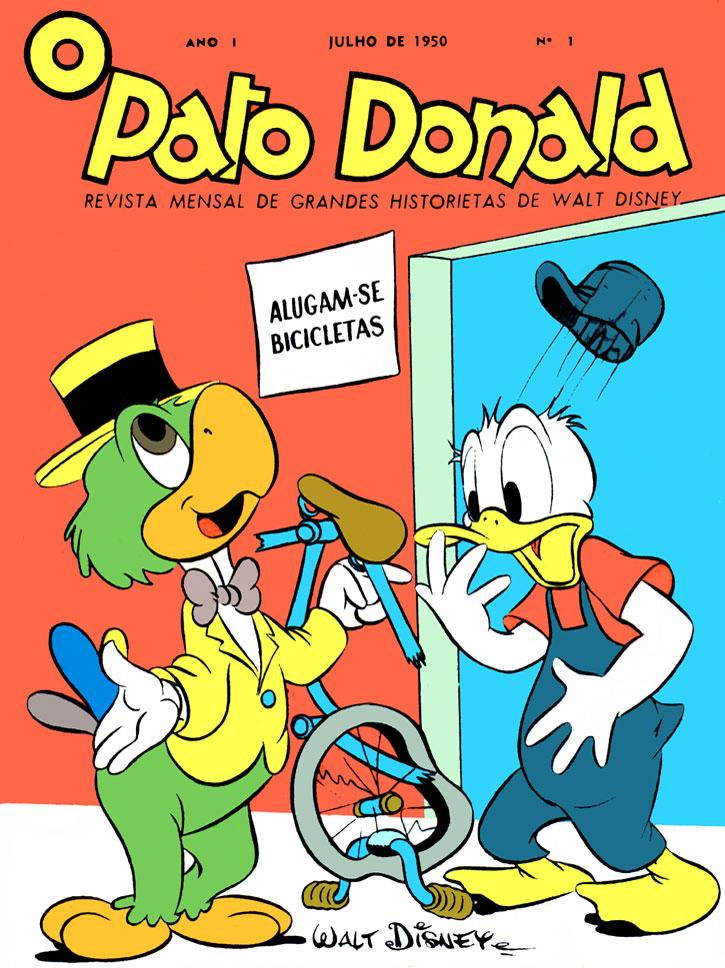
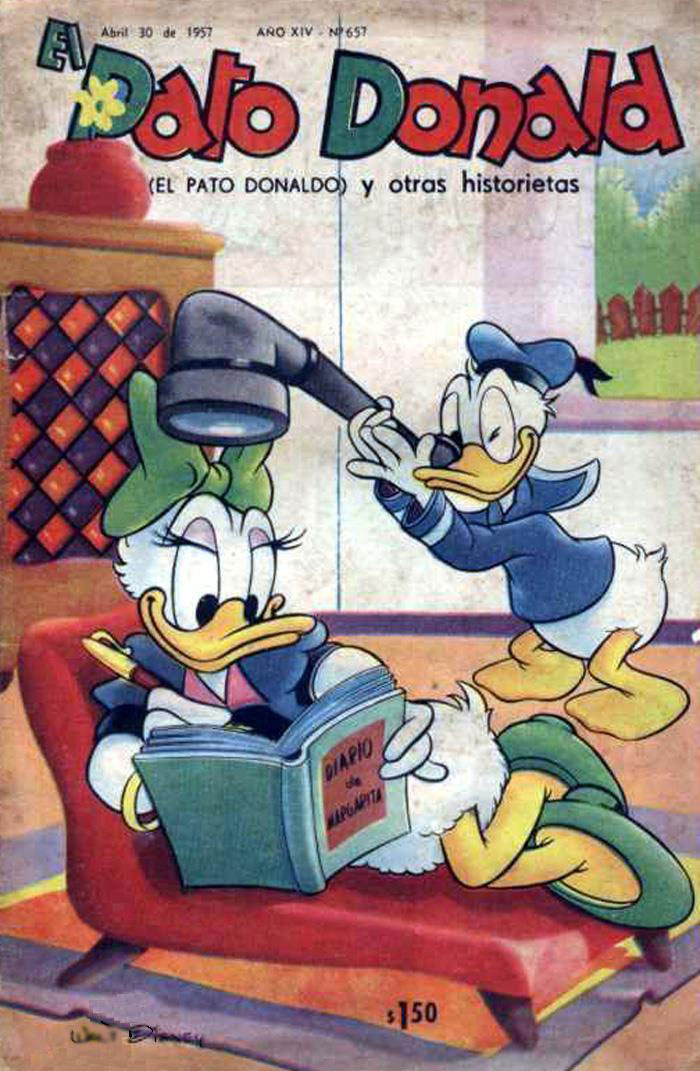
Cover artwork for the first issue of O Pato Donald in Brazil (July 1950) and issue #657 of El Pato Donald in Argentina (30 April 1957). © Disney
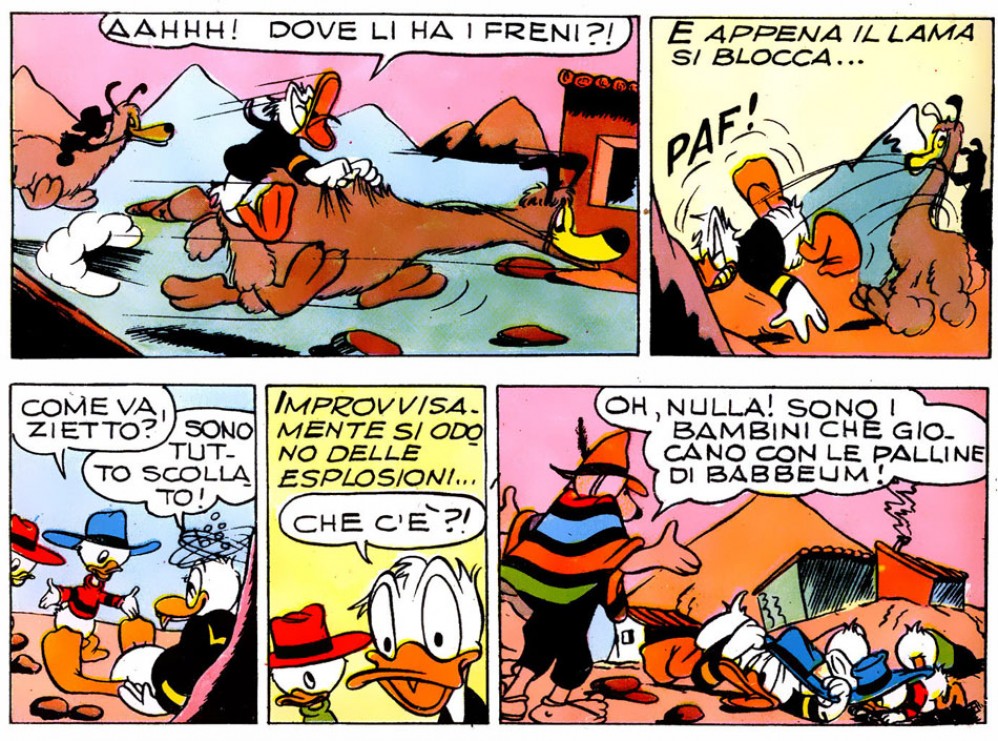
Between 1945 and 1960, Destuet created a great many serials and shorter stories with Donald and his family for El Pato Donald. In these tales, the Disney duck tried his hand at new sports, like car racing and basketball, while going on adventures to South American locations like a Brazilian coffee plantation or Macchu Picchu in Peru, often with Pete as the recurring villain. In 'Donald y la Atomica' (1952), Donald and his nephews accidentally discover the formula for an atomic explosion. Several of these stories were later reprinted in the monthly supplement title 'La Gran Historieta', and appeared internationally in Brazilian and Italian Disney titles.
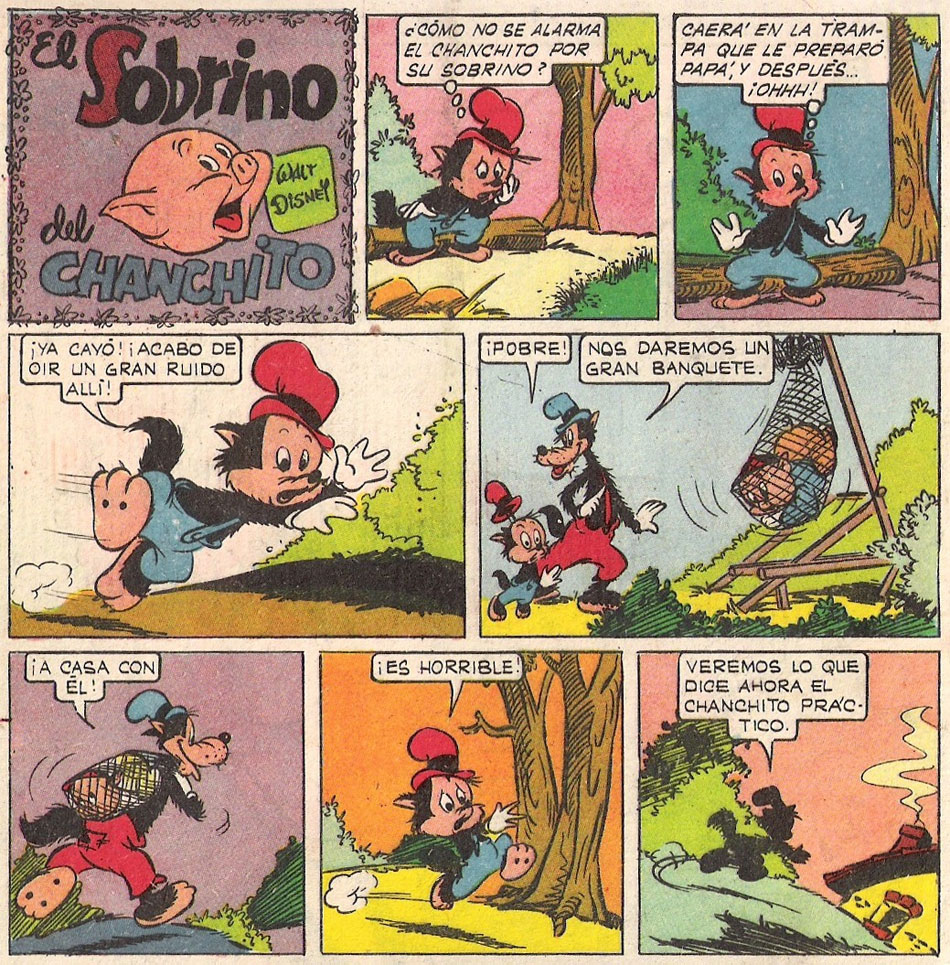
'Big Bad Wolf' (El Pato Donald #557 (1955). © Disney
When the format of El Pato Donald was enlarged in October 1947, Destuet became responsible for most of the cover illustrations and specially created new opening panels for reprints of American stories. In addition, Destuet made illustrations for El Pato Donald's editorial pages and short text stories. Besides Donald and his family, Destuet also drew comic stories with other Disney characters, notably the 'Li'l Bad Wolf' ('El Pequeño Lobo Feroz'), with whom he made several serials throughout the 1950s. In 1952, he also created the first Argentinian-made adventures of Mickey Mouse and Goofy, who appeared in serials dealing with UFOs, a whale, Antarctica and a 3D parody of Baron Munchausen. After Destuet's final Argentinian 'Donald Duck' serial ('Heroe de la Ruta') came to a conclusion in August 1960, the artist continued to provide the cover drawings - since 1958 fully painted - for El Pato Donald until mid-1962. After that, the El Pato Donald title returned to reprints only, until its 996th and final issue in November 1963.
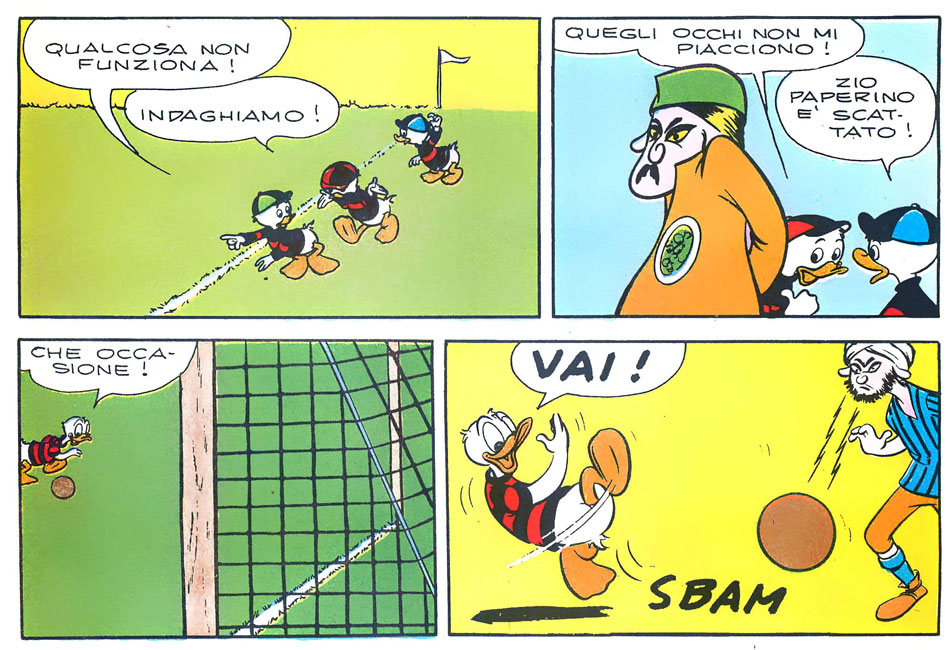
Donald Duck - 'Soccer Magic' (Studio Program story S63057, Brazilian publication). © Disney
International Disney comics
In the meantime, Destuet had also worked for the Brazilian branch of Editorial Abril, led by Cesare Civita's younger brother Victor. Starting in July 1950, the company printed the Brazilian Disney magazine O Pato Donald, which initially ran reprints of American stories and the Destuet serials from Argentina. By 1951, Abril in Brazil was also in need of a story production of its own, and recruited Luis Destuet as a mentor for their local artists, starting with Álvaro de Moya and Jorge Kato. In Brazil, Destuet himself provided a few text story illustrations, as well as some 1950s cover drawings and comic stories, notably starring Brazil's favorite Disney character, the parrot José Carioca.
After 1962, Destuet's departure from El Pato Donald in Argentina didn't mean the end of his Disney tenure. In 1963-1964, he created a handful of 'Donald Duck' and 'Mickey Mouse' stories for Disney's so-called "Studio Program": a story production coordinated by the Disney Studios in Burbank aimed at the several international licensees. By then, it turned out that Destuet's naïve drawing style, which was satisfactory for the local Argentinian market, didn't meet up with that of the Studio Program's other creators, ending his tenure early on.
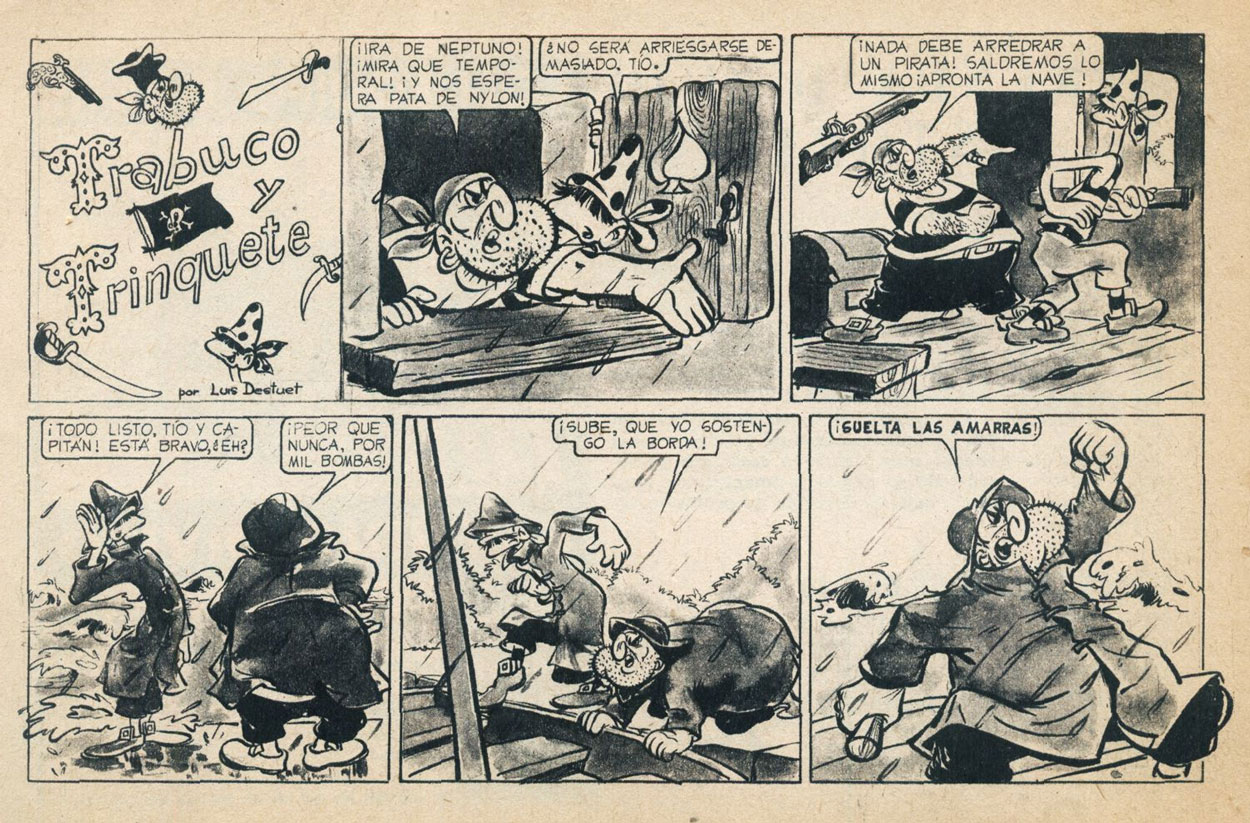
'Trabuco y Trinquete' (1957).
Non-Disney comics
In 1946, Destuet created an additional non-Disney feature for El Pato Donald, a celebrity comic based on the 1940-1952 radio show 'Gran Pensión "El Campeonato"', written by Enrique Dátilo. For another Abril magazine, Salgari, he created 'Trabuco y Trinquete' (1947-1948), a comic feature starring a clumsy uncle-and-nephew pair of pirates. In later years, this feature was resumed in Abril's Raio Vermelho magazine (1950) and in Editorial Frontera's Hora Cero magazine (1957). During his time in Brazil, Destuet also created a comic feature for the women's supplement of the Rio de Janeiro newspaper Diário da Noite. Appearing twice a week, the 'Flechinha' (1951) strip told the mishaps a friendly little cupid accidentally causes with his arrows.
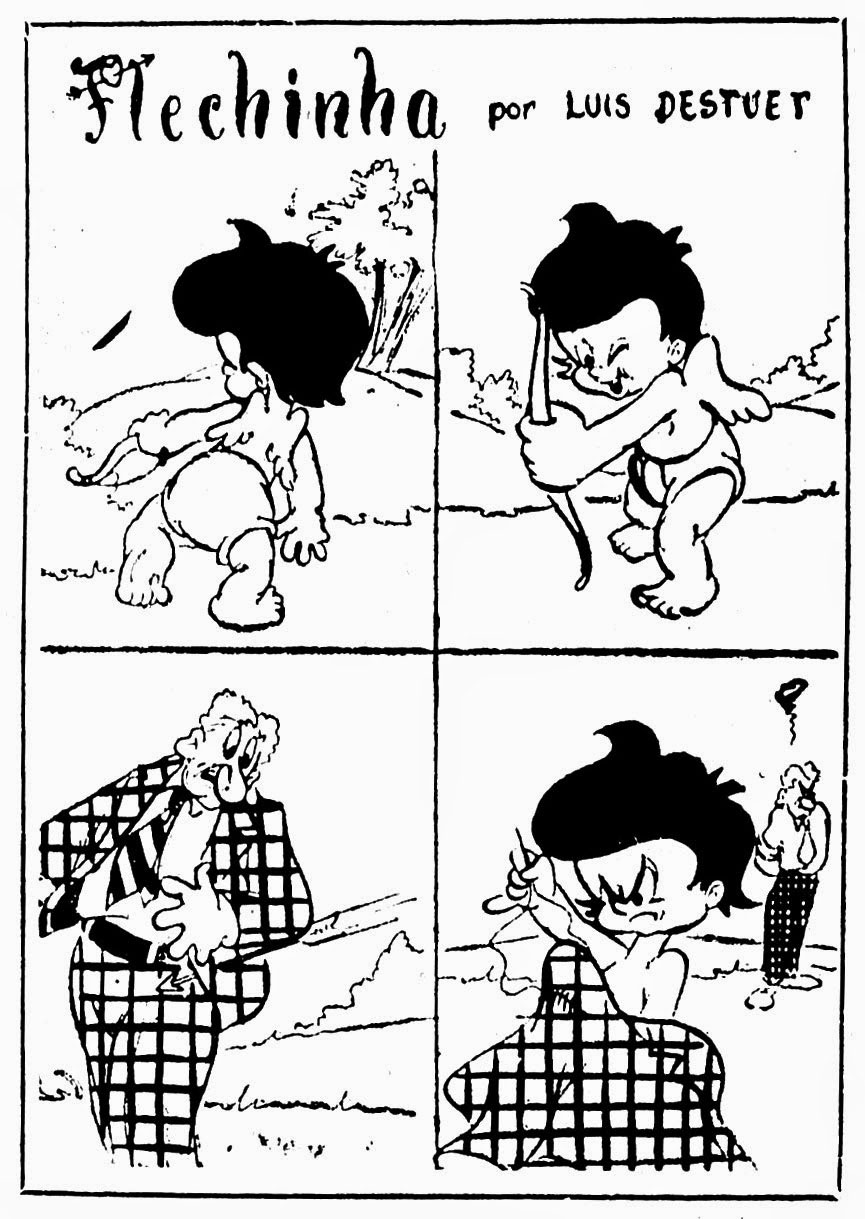
'Flechinha' (1951).
Illustrator and writer of books
In addition, Destuet illustrated children's books, several of which featured Disney characters. One notable book he illustrated was an Argentinian edition of 'The Rose and the Ring' by William Makepeace Thackeray. As an author, he wrote the youth books 'Gauchos y Gauchitos' (Editorial Sigmar, 1964) and 'Cipriano el Distraído' (Editorial Sigmar, 1977), containing stories about boys and girls living in the Argentinian Pampas Plain. During the 1960s, Luis Destuet was additionally an illustrator for the Buenos Aires children's magazine Billiken.
Luis Destuet died in 2002.
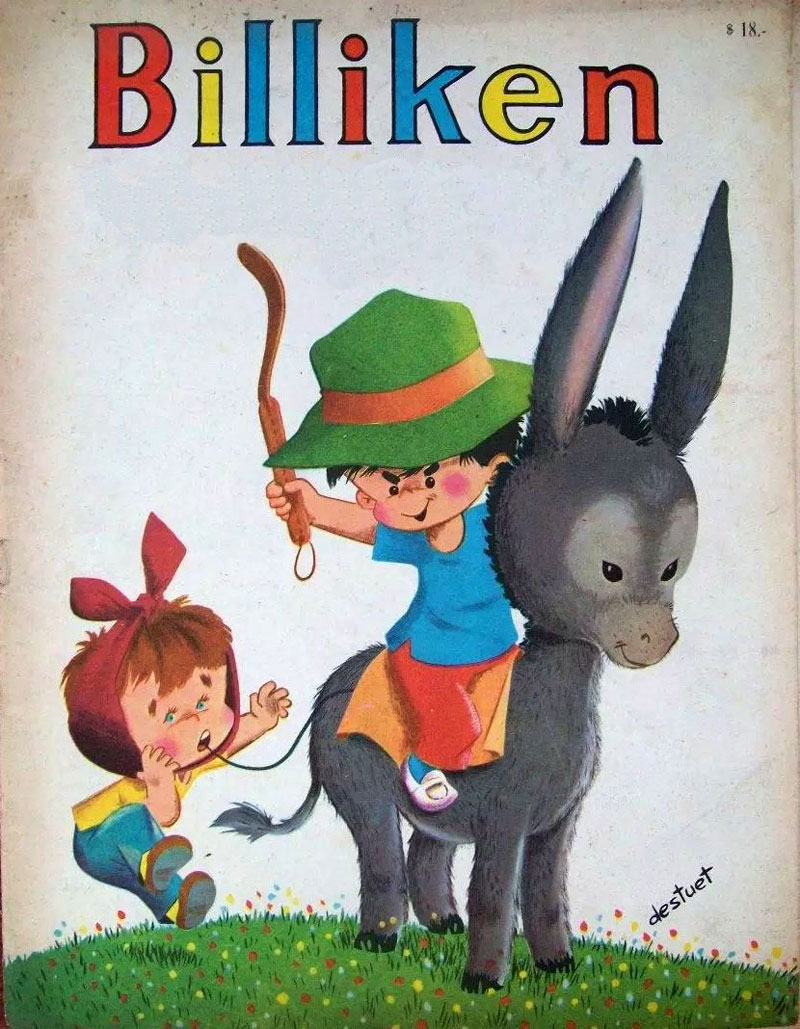
Cover illustration for Billiken (1966).