

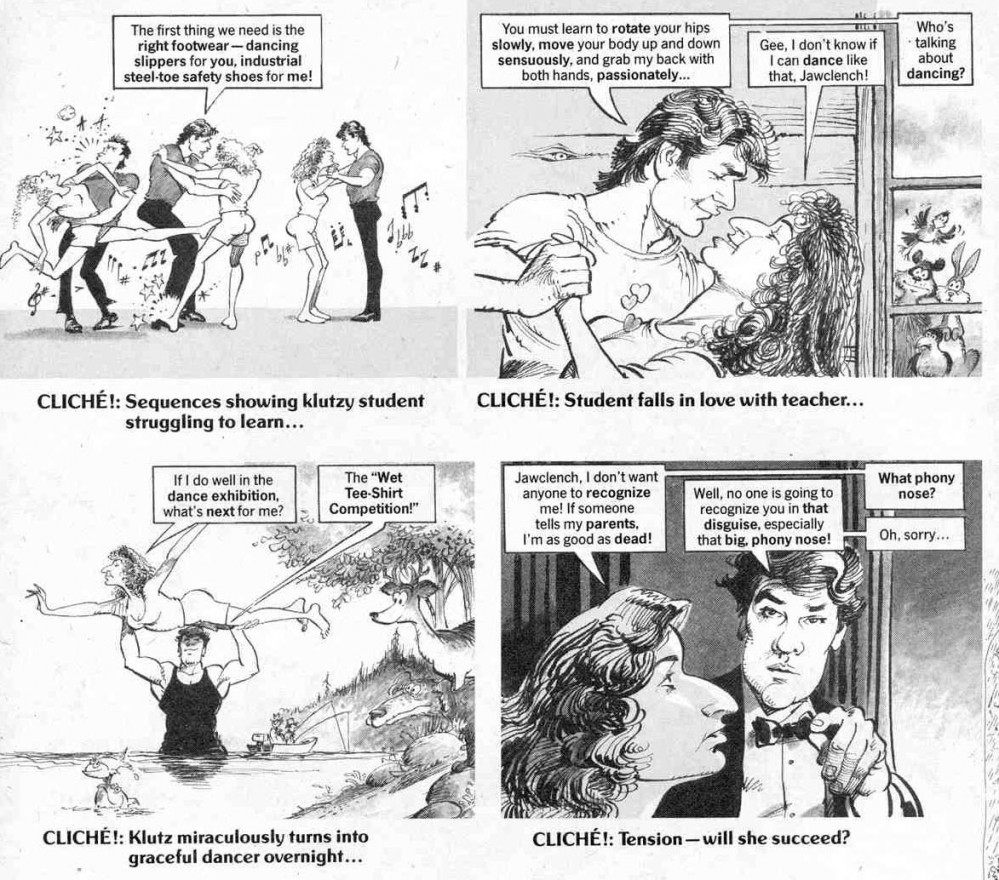
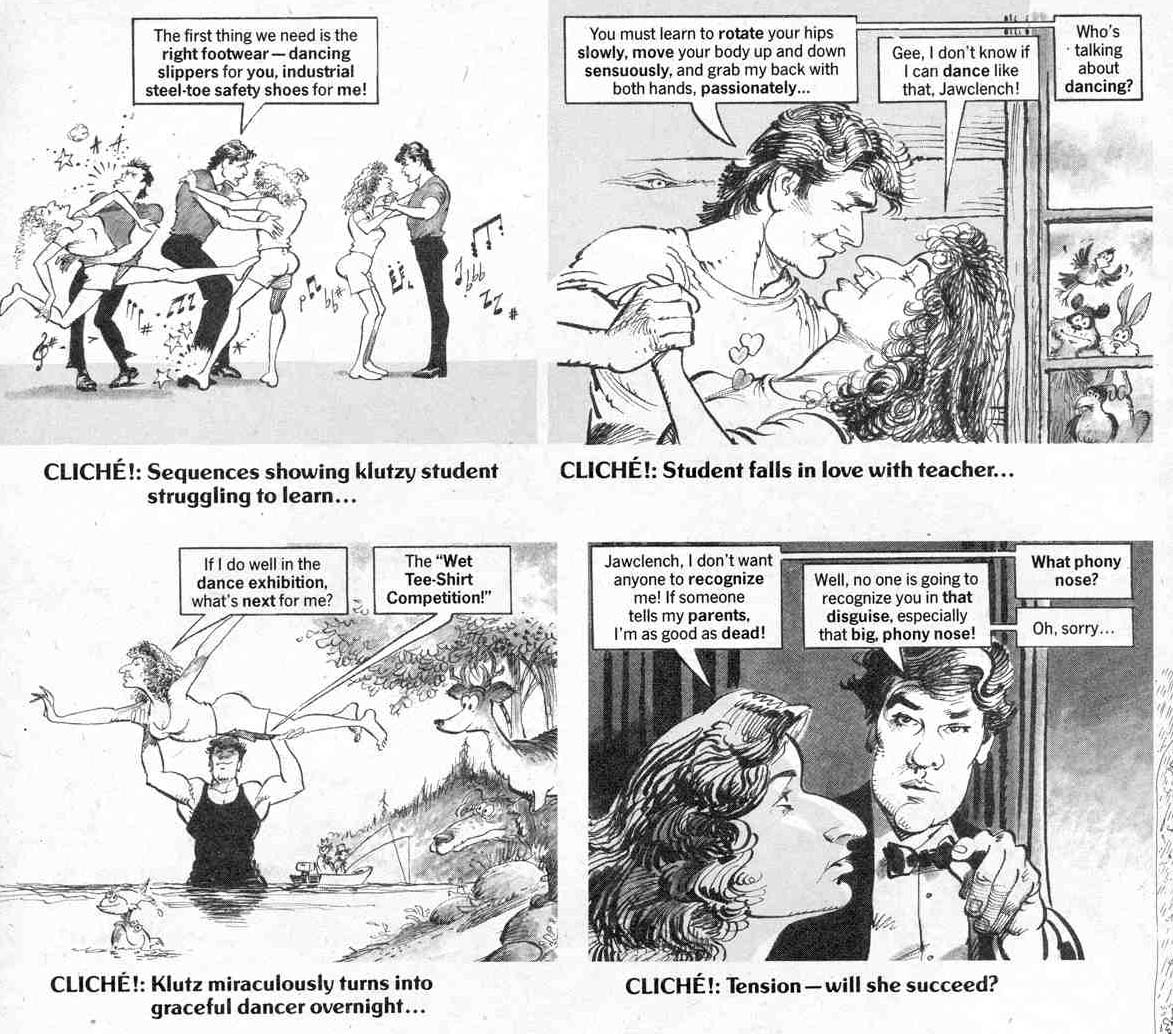
'Dorky Dancing', Hart's 'Dirty Dancing' parody from Mad #278, April 1988 (art by Mort Drucker).
Stan Hart was an American comedy writer, who wrote scripts for various TV shows, alongside works for film and theater. Between 1962 and 2000, he was one of the scriptwriters for Mad Magazine. As part of the "usual gang of idiots", he penned several classic film and TV parodies, alongside general satire. Outside the magazine itself, he also penned various Mad paperback and co-wrote the Broadway musical 'The Mad Show' (1966). Hart was also active at the Topps trading cards company.
Early life and career
Stan Hart was born in 1928. He studied at Stuyvesant High School and spent his higher education at the City College of New York, Columbia University and Apex Tech.
Mad Magazine
In 1962, Hart started his association with Mad Magazine. He remained one of their regular and most long-running contributors for three decades, lasting until 2000. Interviewed for Mad XL #8 (March 2001), Hart said he was most proud of his article 'Broken Homes and Gardens', which presented a magazine aiming at children who went through a divorce. It appeared in issue #179 (December 1975), illustrated by Jack Rickard.
Mad Magazine: Film parodies
Like many of his colleagues, Hart wrote various film parodies. His earliest spoof, targeting 'Lawrence of Arabia' (issue #86, April 1964) was co-written with Larry Siegel and Frank Jacobs and drawn by Mort Drucker. His first solely scripted Mad film parody was 'Bunny Lake Is Missing' (issue #102, April 1966), also drawn by Drucker. With Drucker behind the pencil, Hart additionally ridiculed movies like 'The Sound of Music' (issue #108, January 1967), 'The Graduate' (issue #122, October 1968), 'Midnight Cowboy' (issue #134, April 1970), 'Summer of '42' (issue #148, January 1972), 'Death Wish' (issue #174, April 1975), 'Rocky' (issue #194, October 1977), 'Close Encounters of the Third Kind' (issue #200, July 1978), 'Grease' (issue #205, March 1979), 'An Officer And A Gentleman' (issue #238, April 1983), 'Top Gun' (issue #267, December 1986), 'Fatal Attraction' (issue #279, June 1988), 'Dances With Wolves' (issue #305, September 1991), 'Sister Act' (issue #316, January 1993) and 'The Green Mile' (issue #393, May 2000).
Hart and Drucker's parody of 'Summer of '42' in issue #148 (January 1972) received an appreciative letter in issue #150 (April 1972) from actor Jerry Houser ('Husky' in the film), calling it "both a shock and thrill". After Hart and Drucker parodied 'Death Wish' in issue #174 (April 1975), actor Vincent Gardenia (who played chief Frank Ochoa in the film) expressed his delight in a letter printed in issue #176 (July 1975), with an enclosed photo of him reading the issue. In issue #249 (September 1984), a letter from actress Janet Carroll (the mother in 'Risky Business') was printed, regarding Hart and Drucker's spoof of this movie in Mad issue #246 (April 1984), saying she was "flattered", but still felt the need to add a photo of herself, because "I don't think your artist quite captured me." Coincidence or not, but in issue #258 (October 1985), 'Risky Business' received a longer, full-blown spoof, again drawn by Mort Drucker, but scripted by Arnie Kogen. Actress Marine Jahan (who was Jennifer Beals' body double in 'Flashdance') sent a letter, printed in issue #250 (October 1984), expressing her love for Hart and Drucker's parody of 'Flashdance' (issue #246, April 1984)
Actors Joe Mantegna and Ben Kingsley were photographed in issue #319 (June 1993), holding issue #312 (July 1992), in which their movie 'Bugsy' was spoofed by Hart and Drucker. Hart and Drucker also poked fun at 'Interview With The Vampire' in issue #335 (May 1995) and received a letter from Anne Rice, the novelist on whose book the movie was based, praising it as "right up there with a mention on 'Jeopardy' or in The New York Times Crossword Puzzle! Hell, this is better." It was printed in issue #340 (October/November 1995). In issue #435 (November 2003), a photo of John Travolta holding the Mad issues that spoofed ‘Saturday Night Fever’ (scripted by Arnie Kogen) and ‘Grease’ (scripted by Hart) was printed.
When film director Mike Nichols was interviewed in Entertainment Weekly (15 February 2008) about his film 'The Graduate' starring Dustin Hoffman (spoofed by Hart and Drucker in issue #122, October 1968), he said: "My unconscious was making this movie (...). It took me years before I got what I had been doing all along - that I had been turning Benjamin into a Jew. I didn't get it until I saw this hilarious issue of MAD Magazine after the movie came out, in which the caricature of Dustin says to the caricature of Elizabeth Wilson, 'Mom, how come I'm Jewish and you and Dad aren't?' And I asked myself the same question, and the answer was fairly embarrassing and fairly obvious."
Together with Jack Davis, Hart parodied films like 'E.T.' (issue #236, January 1983), 'The Goonies' (issue #258, October 1985) and 'Gone With the Wind' (issue #300, January 1991). Hart and Angelo Torres joined forces to spoof pictures like 'Billy Jack' (issue #168, July 1974), 'Rambo III' (issue #283, December 1988) and 'Mrs. Doubtfire' (issue #327, May 1994). After spoofing ‘Apollo 13’ in issue #341 (December 1995), Hart and Torres received an appreciative letter from both film director Ron Howard and Jeffrey Kluger (co-writer of the book on which the film was based).
With George Woodbridge, Hart poked fun at 'A Clockwork Orange' (issue #159, June 1973). Hart's spoofs of 'Midnight Cowboy' (about a male prostitute) and 'A Clockwork Orange' (about a gang leader and serial rapist subjected to brainwash treatment) can be considered two of the most unlikely and daring film parodies in Mad. Jon Voight, who played one of the two leads in 'Midnight Cowboy', wrote to Mad, printed in issue #136 (July 1970), saying that, despite "not being much of a reader" he read it all in "just one sitting." 'A Clockwork Orange’ had already achieved additional controversy by the time the spoof was printed in Mad, inspiring several copycat crimes, making Kubrick pull the picture from roulation in the United Kingdom. In hindsight, one can’t help but wonder what Hart and Woodbridge were thinking when they picked it out as a parody subject, since they couldn’t even visualize or explicitly mention various sexually explicit but crucial scenes. The nudity remains off screen and the scene where Alex murders a woman with a penis sculpture is changed to him using a bust of Disney’s Dumbo instead.
With Sam Viviano, Hart lampooned movies like 'Coming To America' (issue #284, January 1989), 'Home Alone' (issue #303, June 1991) and 'The Truman Show' (issue #374, October 1988). Between issue #289 (September 1989) and issue #310 (April 1992), Hart launched the 'Mad Video Review' series (1989-1992). These were basically spoofs of Hollywood blockbusters that Mad had missed when they were still in theaters. Thanks to home video, they still had a chance to lampoon them, though not in the usual full-blown three to six pages-long comic strip parodies. Instead, they tackled eight movies in one episode, but usually in no less than two to four panels, illustrated by Sam Viviano and one episode (issue #302, April 1991) by Mort Drucker. Among the movies covered in this series were, for instance, 'Die Hard', 'The Last Temptation of Christ', 'When Harry Met Sally', 'National Lampoon's Christmas Vacation', 'Kindergarten Cop', 'Misery' and 'Thelma and Louise'.
Hart also satirized both 'Gremlins' movies, Tim Burton's 'Batman' and 'Batman Returns' and three Walt Disney movies ('Beauty and the Beast', 'Aladdin' and 'The Lion King'). In issue #291 (December 1989), a photo was printed of Jack Nicholson reading Hart and Drucker's spoof of Burton's 'Batman'. Hart had most fun writing Mad's parody of 'Dirty Dancing' (1987), drawn by Mort Drucker in issue #278, April 1988. Hart claimed that this picture was so full of tired old clichés that he had to keep a list. When creating their comic strip parody, he wrote down at least one at the bottom of each panel. The only other Mad movie satire to ever reach a similar cliché summary amount in the footnotes of every panel was 'Detroit Rock City' in issue #385 (September 1999), written by Desmond Devlin and illustrated by Ray Alma.
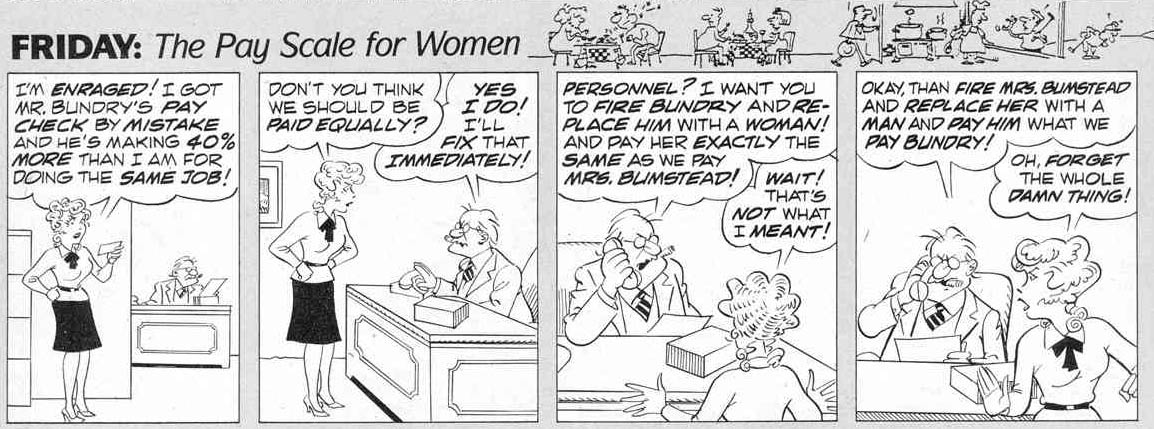
'If Blondie Entered the Real Work Place' (Mad #310, April 1992), a parody of Chic Young's 'Blondie' comic strip (art by Angelo Torres).
Mad Magazine: TV parodies
Within Mad's pages, Hart naturally also wrote parodies of TV series. With Mort Drucker as artist, he spoofed 'The Fugitive' (issue #89, September 1964), 'Peyton Place' (issue #95, June 1965), 'The A-Team' (issue #242, October 1983), 'Roseanne' (issue #287, June 1989), 'The Fresh Prince of Bel-Air' (issue #303, June 1991), 'Seinfeld' (issue #327, May 1994) and 'NYPD Blue' (issue #329, July 1994). In issue #308 (January 1992), Hart and Drucker ridiculed the TV show ‘Northern Exposure’ and received an appreciative letter from actor Rob Morrow (who played Dr. Joel Fleischmann) in issue #320 (July 1993). In issue #330 (September 1994), a letter was printed by TV journalist Dan Rather, who'd received a cameo in their spoof of 'Seinfeld', three issues back. Rather wrote to complain about the fact that he never watched 'Seinfeld', since it appears opposite 'Eye to Eye with Connie Chung', therefore not understanding why he was randomly added in the parody. He also informed Mad that his haircut wasn't up-to-date with the way Drucker had drawn it: "Mort Drucker may be the most talented caricaturist in America, but he's working from outdated, inaccurate publicity stills."
Hart also teamed up with Angelo Torres to create Mad's first parody of the TV sitcom 'M*A*S*H*' issue #166, April 1974). The second spoof of the same series ran in issue #234 (October 1982), scripted by Arnie Kogen and drawn by Jack Davis. While the original movie by Robert Altman, 'M*A*S*H*', was scripted by Kogen and Torres, the TV spin-off 'After M*A*S*H*' in issue #247 (June 1984) was again made by Hart and Torres. Shows like 'I Spy' (issue #111, June 1967), 'Chico And The Man' (issue #177, September 1975), 'Barney Miller' (issue #195, December 1977) and 'Taxi' (issue #212, January 1980) were also tackled by Hart and Torres. Finally, he also penned the spoof of the sitcom 'The Wonder Years' (drawn by Sam Viviano, issue #291, December 1989).
Mad paperbacks and other activities
Hart wrote various paperback compilations for Mad, namely 'The Mad Book of Revenge' (1976), 'The Mad Guide to Careers' (1978), 'The Mad Survival Handbook' (1980), 'Mad's Fast Look at Fast Living' (1982), all illustrated by Paul Coker, and 'A Mad Guide to Parents, Teachers and Other Enemies' (1985), drawn by Jack Davis. Together with Larry Siegel, Steven Vinaver, Marshall Barer and Stephen Sondheim, Hart wrote the Broadway musical 'The Mad Show' (1966), with music composed by Mary Rodgers.
Topps
Like many other Mad associates, Hart worked for Topps Card Company, creating trading cards like 'Garbage Pail Kids' and 'Wacky Packages'. According to Art Spiegelman, it was Hart who ignited the spark to create a parody of the 'Cabbage Patch Kids', which would eventually become the 'Garbage Patch Kids' franchise. He merely told the others to "create a parody of something", but this was enough to lead them to the idea.
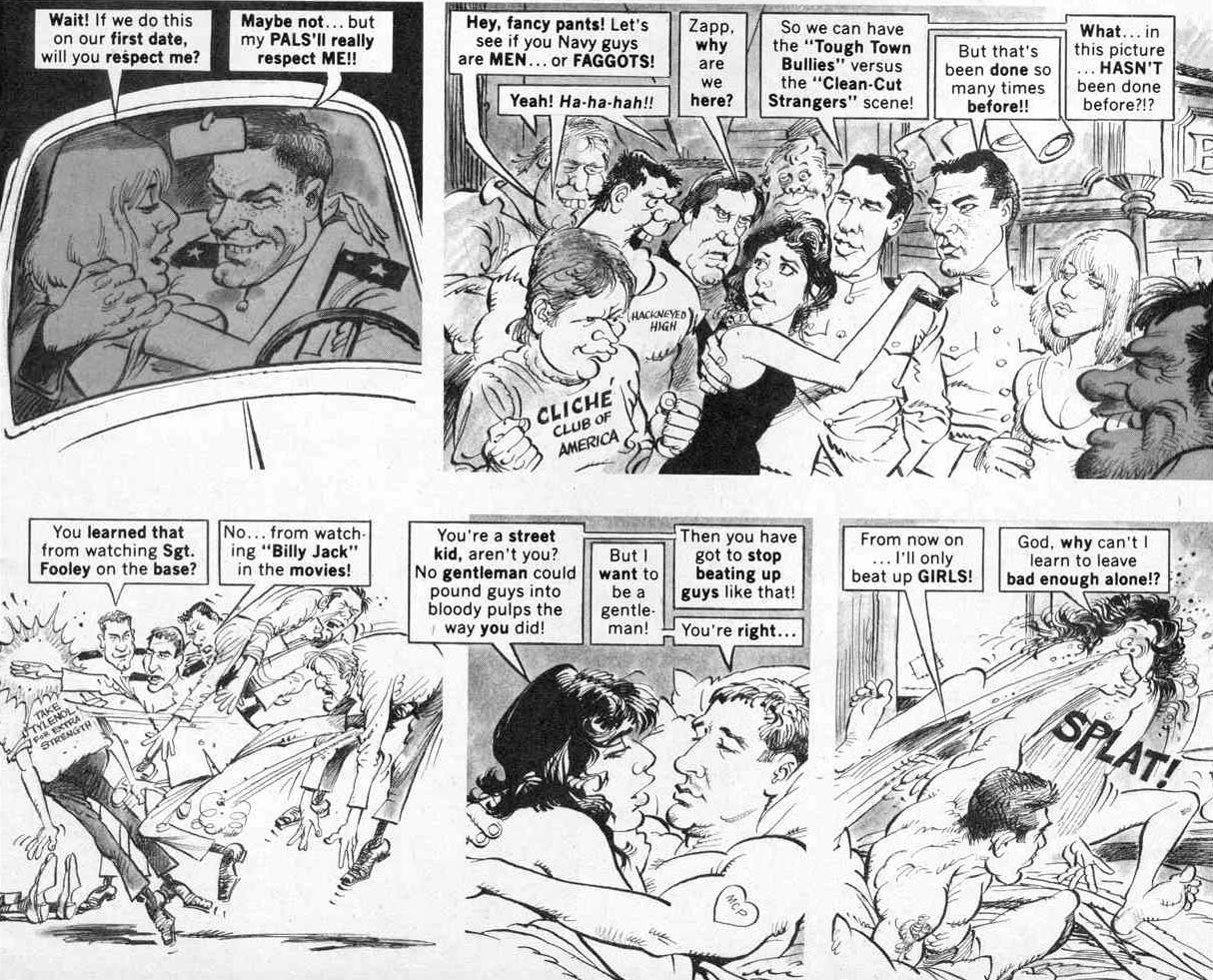
'An Officer Ain't No Gentleman' from Mad #238, April 1983 (art by Mort Drucker).
TV career
Outside the comic industry, Hart was also active as a TV screenwriter. He was involved with the never-aired TV pilot 'Wonder Woman: Who's Afraid of Diana Prince?' (1967), the first attempt to adapt William Moulton Marston's 'Wonder Woman' to the small screen. He wrote numerous episodes of the variety show 'The Carol Burnett Show' (1970-1972). By the sixth season, he was show's main writer and received two Emmy Awards for his contributions. He wrote the script for the episode 'Walt Disney : One Man's Dream' (1981) for the TV series 'Disneyland'.
Film career
Hart and his son, Christopher Hart, co-wrote the script for the SF comedy film 'Eat and Run' (1986), directed by Christopher Hart. The wacky story dealt with a humanoid extraterrestrial alien who lands on Earth and starts devouring Italian-Americans in New York City. The picture flopped at the box office and is nowadays forgotten.
Final years and death
Stan Hart retired in 2000 and became a writing consultant for Youth Theatre Interactions, a performing arts school in Westchester County. He passed away in 2017 from progressive supranuclear palsy, at age 88.
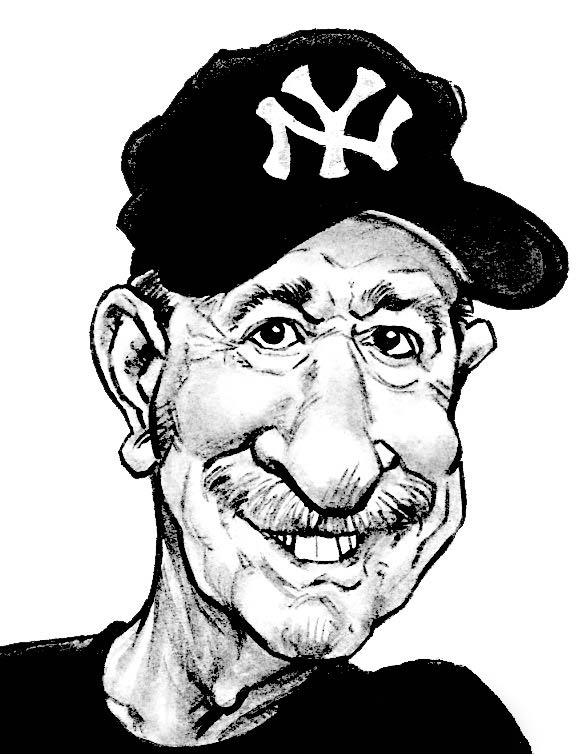
Stan Hart by Sam Viviano.