

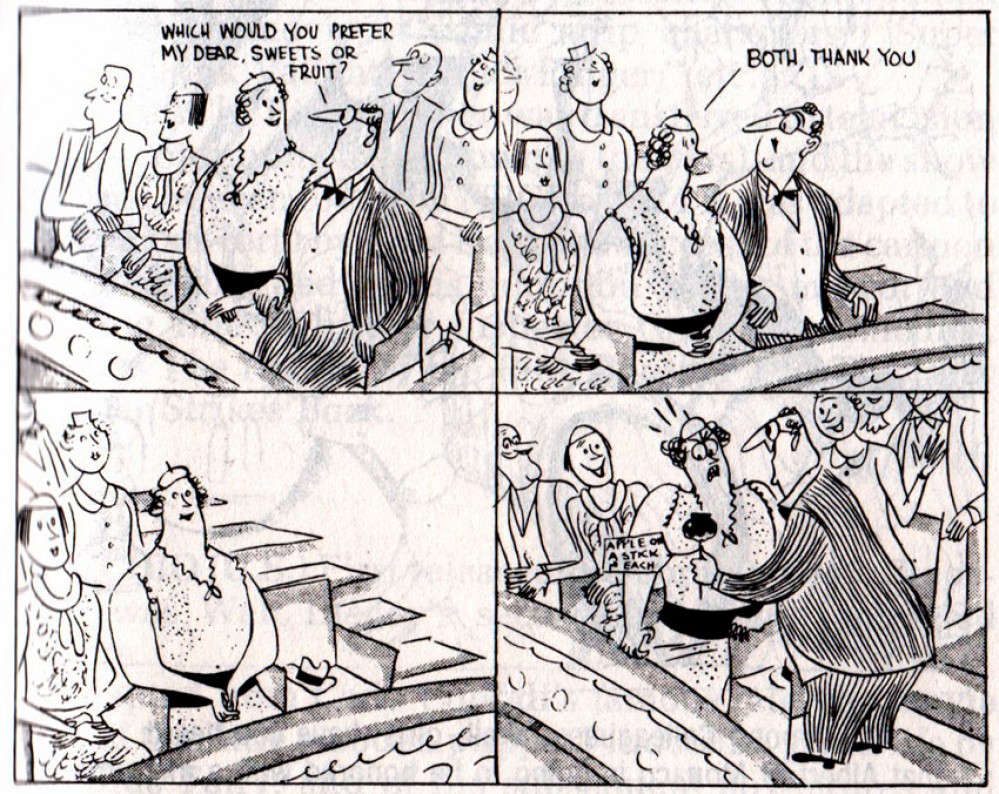
'In and Out of Society' (1934).
William Pidgeon, also known as Bill Pidgeon or "Wep", was a mid-20th century Australian cartoonist and painter, recognized for his gentle depictions of society and his work as a war artist. During the 1920s and 1930s, he had stints on many of the Sydney newspapers, creating cartoons, illustrations and the occasional comic strip, until he found a more steady homebase in the newly launched The Australian Women's Weekly in 1933. Until the 1950s, he provided the magazine with painted cover drawings, witty illustrations and his signature comic feature, 'In and Out of Society' (1933-1949). Later in life, he was mostly active as a portrait painter.
Early life and career
William Edwin Pidgeon was born in 1909 in the Sydney suburb of Paddington, as the youngest son of leaded-window maker Frederick Castledine Pidgeon. His father also made life drawings and oil paintings, which strongly inspired Bill Pidgeon's own interest in art. A personal acquaintance of his father was the artist Fred Leist, who later became a strong graphic influence on the boy's work. When he was four years old, in 1913, Pidgeon's father died prematurely, after which he, his mother and older brother John temporarily moved into his grandfather's home, which was called "Trelawney". In Paddington, Pidgeon attended the Glenmore Road Public School and then Darlinghurst Public School until 1921. Subsequently, he went to study at Sydney Technical High School and briefly spent some time at J.S. Watkins art school and East Sydney Technical College.
His first comics appeared in the latter school's paper, where in 1923 he first used his initials "Wep" as a pseudonym. Among his graphic influences were painters Pieter Bruegel the Elder, Paul Cézanne, Paul Gauguin, Hokusai, Hans Holbein the Younger, Henri Matisse, Pierre-Auguste Renoir, Peter Paul Rubens, Henri de Toulouse-Lautrec, Rembrandt van Rijn and Vincent van Gogh. His favorite cartoonists were Peter Arno, Henry Mayo Bateman and Miguel Covarrubias.
Despite showing talent, Pidgeon originally wanted to become an electrical engineer. After graduation in 1925, he worked as an office boy at the pressed metal ceiling factory Wunderlich Ltd, Redfern, where he came into contact with the company's advertising draughtsman William Dobell, who became a lifelong friend and inspiration.
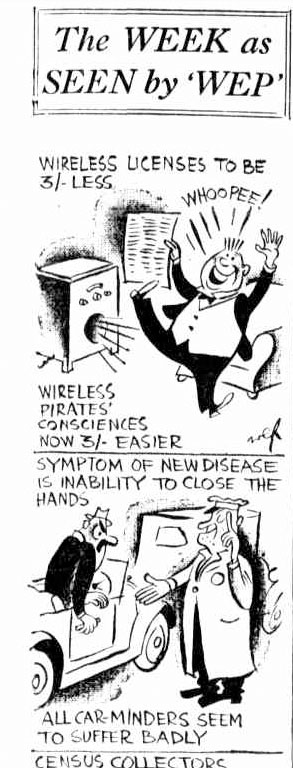
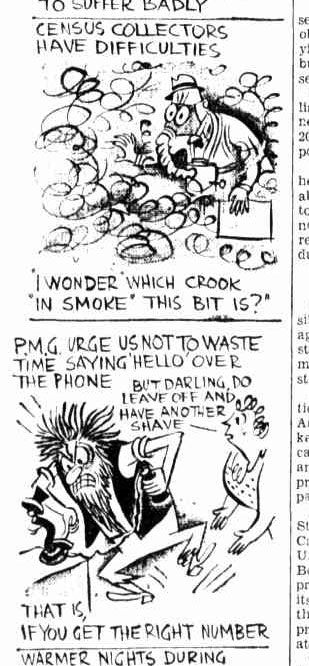
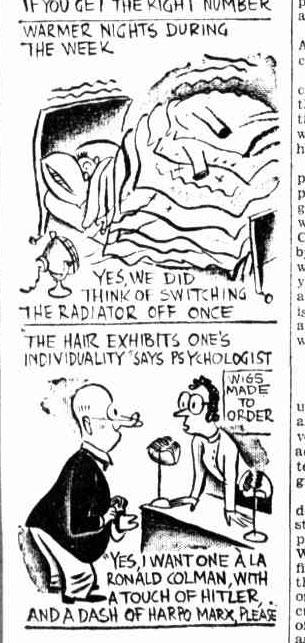
'The Week As Seen By Wep' of 2 July 1933 (The Sun).
Editorial cartooning career
Pidgeon was only 16 years old when by chance he became a "Cadet Newspaper Artist" for the Sydney Evening News and its Sunday News edition. His uncle Septimus was a dentist and one of his patients happened to be Marmion Dart, the editor of the paper. On 12 April 1925, his first cartoon, 'A Crossword Tragedy', saw print in the Sunday News. In September of the following year, he launched his first gag comic feature, 'The Trifling Triplets', which ran in the same paper for nine months, after which it was succeeded by Win Fry's 'The Coo Coos' and then Harry Eyre's 'Micko and his Monk'.
In September 1927, Bill Pidgeon left the Evening News and joined editor Sydney's The Daily Guardian and Smith's Weekly, both published by Smith's Newspapers Ltd. Continuing work as a newspaper artist, he began a friendship and creative partnership with his editor George Warnecke, whom he also joined in the launch of The Sunday Guardian in 1929. In this Sunday paper, Pidgeon illustrated the weekly column of humorist Lennie Lower. When in 1931 the Guardian was acquired by the Associated Newspapers, Bill Pidgeon was fired (according to the cartoonist because he drew pointed noses, just like his new managing editor had).
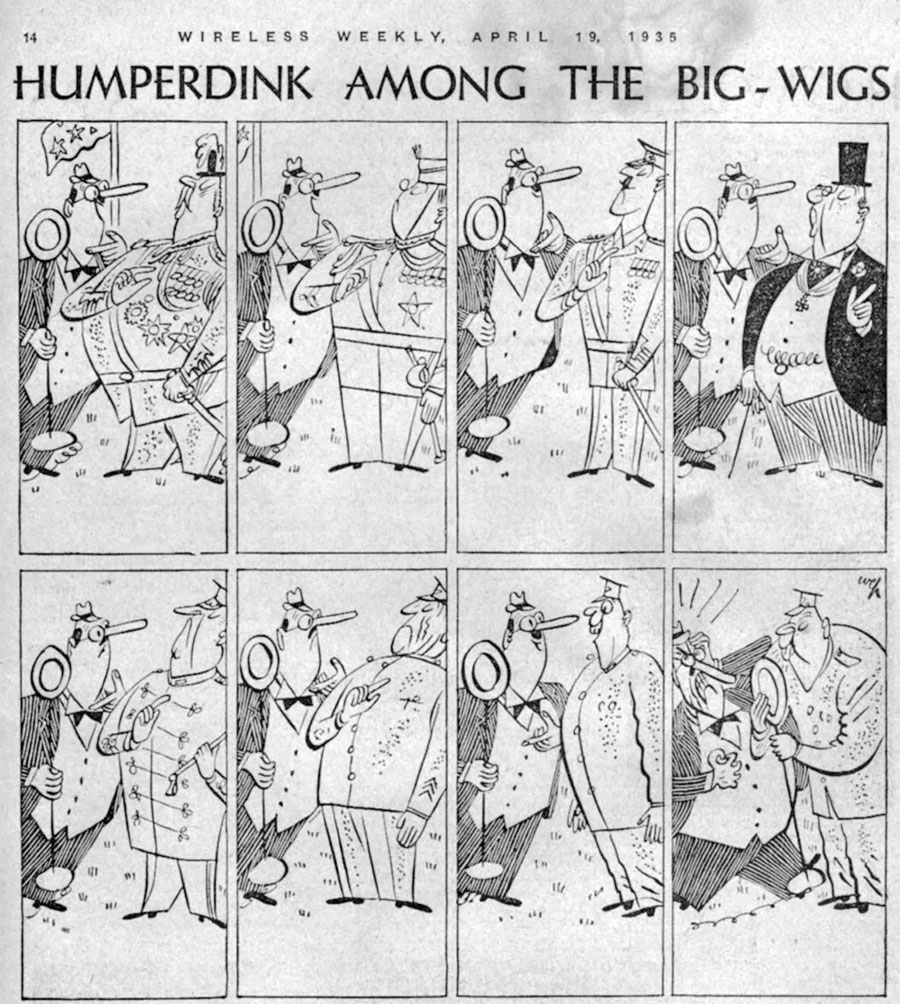
'Humperdink' strip from Wireless Weekly of 19 April 1935.
During the years of the Great Depression, Bill Pidgeon was largely forced to do freelance work. Already in February-March 1929, his art additionally appeared in The Advertiser, a tabloid from Adelaide, where he illustrated the serial 'The India-Rubber Men' by Edgar Wallace. During the 1930s, he did illustrations for poetry books by the publishers Sunnybrook Press and Frank C. Johnson Publications, and contributed to several magazines and newspapers. In October 1931, he was on the staff of the newly launched The World, a newspaper published by the Australian Worker's Union. However, this adventure lasted only one year, as the paper folded in November 1932.
After that, Wep's collaborations expanded. Returning as a cartoonist in the pages of the Sunday Sun (April 1932-August 1933), he notably created caricatures of movie stars in the section 'Film Faces', as well as, starting February 1933, the feature 'The Week As Seen By Wep', a long vertical column with six cartoons. Until 1938, another regular client of Bill Pidgeon was Wireless Weekly, a magazine covering technology news, receiver designs and listings of both amateur and commercial radio stations. Besides cover illustrations, he provided the magazine with the comic strip 'The Progress of Mr. Humperdink' (1933-1935). In addition, his cartoons and illustrations appeared in the Arrow, The Daily Telegraph, The Referee, To-Day, The Bulletin and The Australian Women's Mirror.
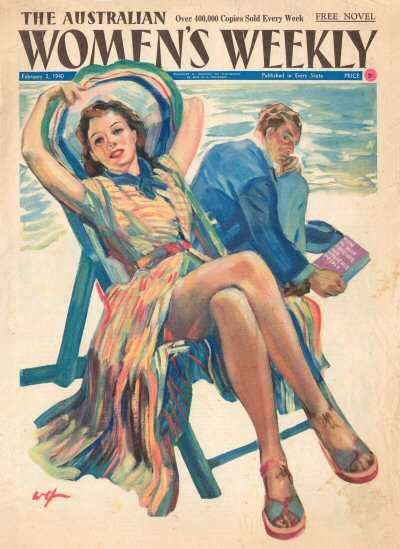
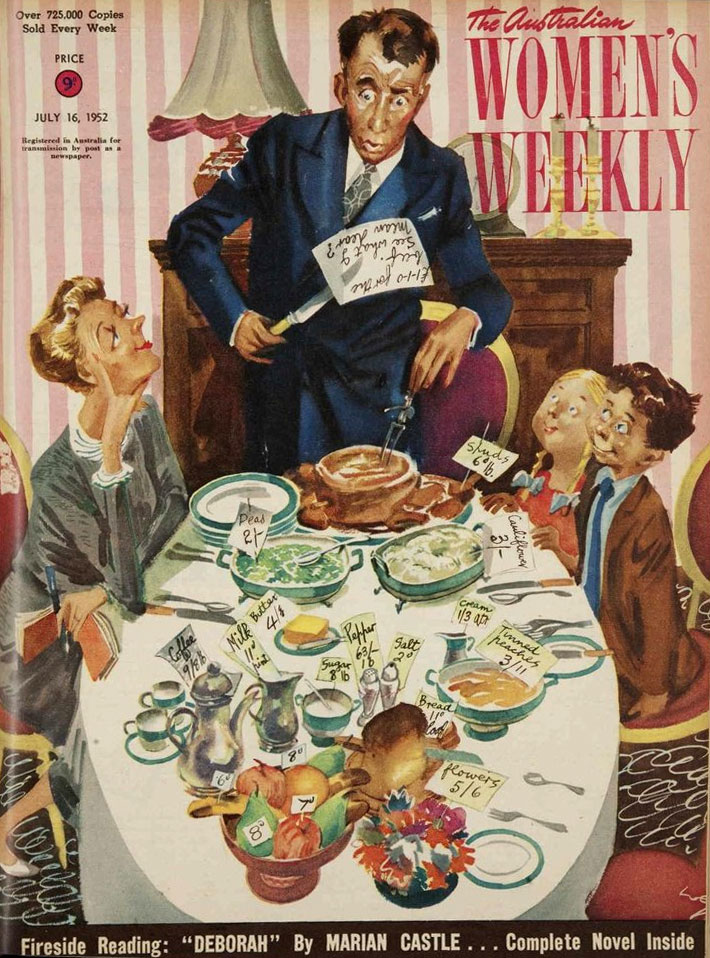
Cover illustrations for The Australian Women's Weekly.
The Australian Women's Weekly
To general audiences, William Pidgeon was most recognizable as one of the house illustrators of The Australian Women's Weekly, an initiative of his editor friend George Warnecke. In early 1933, he worked with Warnecke on the initial dummy of the magazine, and remained involved after the official launch by Sydney Newspapers in July 1933. Each issue featured comics, cartoons and illustrations by him, some of which became classics. Well remembered became his painted cover drawings, in the tradition of Norman Rockwell. Like he had done before in The Sunday Guardian, Pidgeon livened up the humorous columns of Lennie Lower, increasing the popularity of the magazine from the mid-1930s onwards.
On his own, Wep had an, initially unnamed, comic strip/cartoon feature, in which he gently satirized everyday life and societal trends from the viewpoint of the emancipated modern woman. By September 1933, the feature got the title 'In and Out of Society', which became a well-known fixture in the magazine for decades to come. Into the 1970s, it still appeared, although by then continued by other artists.
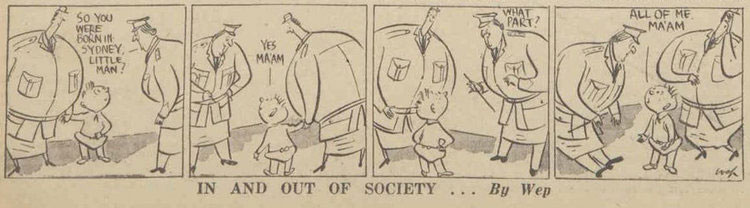
'In and Out of Society'.
Consolidated Press
In 1936, Sydney Newspapers merged with the Associated Newspapers into the Consolidated Press to acquire The Daily Telegraph. This again expanded Pidgeon's activities, as he not only continued his work for the Women's Weekly, but also became the house political cartoonist of The Daily Telegraph and the Sunday Telegraph, until January 1949. Between 1944 and 1947, he also was the paper's art critic. By June 1943, he applied for accreditation as an Official War Artist, and sketched the World War II conditions in New Guinea and Borneo for the Consolidated Press newspapers. For the Australian Women's Weekly, he additionally made paintings and illustrations depicting the Australian war effort in the Pacific Ocean war zone.
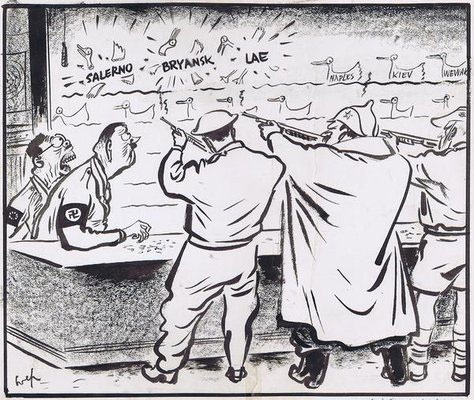
"Allied Shooting Gallery" (Sydney Sunday Telegraph, 25 September 1943). The two men behind the counter are Hideki Tojo and Adolf Hitler.
Later cartooning career
Around 1949, Pidgeon resigned from the Consolidated Press to pursue his interest in fine arts. However, throughout the 1950s, he continued to contribute the occasional cover painting to the Women's Weekly, although by then the title had largely switched to using photographs. During the 1950s and 1960s, he supplemented his income with doing book illustrations, and cartoons for the Australian Monthly A.M. journal (1948-1951) and the Australian Journal (1955-1956), as well as creating the 'Victa News' comic strip (1959-1969).
Painter
Between 1949 and 1972, Pidgeon reinvented himself as a portrait painter, switching to signing with "W.E. Pidgeon" or simply "Pidgeon". He was a member of the Journalists' Club in Sydney and painted the portraits of practically every club president up to 1976. In 1965, he was one of the founding members of the Lane Cove Art Society. Pidgeon's woodcut illustrations for Carboni Raffaello's 'The Eureka Stockade' (1937) were given to US President Franklin D. Roosevelt by attorney-general Dr. H.V. Evatt, who praised the artwork.
In 1945, two of Pidgeon's war-time paintings received First Prize awards for the "Air and Medical Sections" of the national exhibition 'Australia at War'. Pidgeon won the Archibald Prize for portrait painting three times, respectively in 1958 (of Daily Telegraph chief editor Ray Walker), 1961 (of Rabbi Dr I Porush) and 1968 (of landscape painter Lloyd Rees).
Final years and death
Diagnosed with glaucoma in 1956, Pidgeon underwent six operations to fix his eyesight, but by 1973 he was forced to reduce his graphic career to a minimum. Now declared legally blind, Pidgeon kept his condition secret from the outside world, afraid of no longer receiving commissions. He managed to keep making illustrations, even fill in for the political cartoonist of the Sunday Telegraph for two years (1974-1975) and, between 1974 and 1979, served as art critic for the same paper. He visited exhibitions and inspected the artworks with a literal magnifying glass.
In 1979, Pidgeon was trimming bushes on a step ladder in the laneway beside his home when he was hit by his neighbor's car. He was never the same afterwards and passed away in 1981 in the hospital, at age 72.
In 2014, most of Pidgeon's war-time archives were donated to the Australian War Memorial.
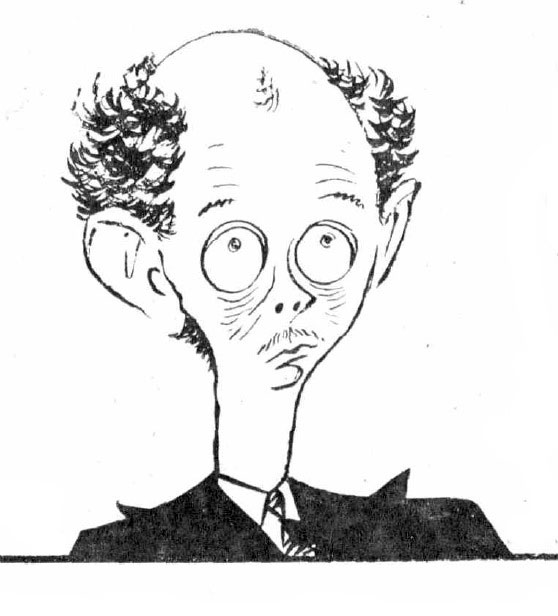
Self-portrait (1940).